


Employee survey questions: 150+ examples and templates
How and what to ask in an employee survey
Employee survey questions are the prompts organizations use to measure how employees feel about their work, manager, team, and company. The best questions tie to a clear objective, cover one topic at a time, avoid leading language, and use a consistent scale so results can be compared over time.
Key takeaways
- 150+ questions, covering all fifteen engagement drivers and six ready-to-run templates.
- Write the objective before you write a single question. The objective decides what belongs in the survey.
- One question, one topic. A question that asks two things returns an answer you cannot act on.
- Use one five-point scale and keep the wording identical every cycle, or the trend means nothing.
- The questions are half the job. What you do in the four weeks after the results land is the other half.
Virtually all companies, big or small, run employee surveys at least once a year. Employee surveys are a great way to check the health of your organization and how your employees are feeling about work. The data, when captured, analyzed, and acted on smartly, can improve satisfaction and engagement, reduce attrition, and attract top talent.
But running an employee survey is not as easy as it sounds. Nor is capturing the right data. Your foremost challenge when it comes to running an employee job satisfaction survey, engagement survey, or employee feedback survey lies in choosing the right employee survey questions.
Thanks to Google, there are a million questions available at the click of a button. But would a random mix and match of these survey questions really help you unearth the not-so-obvious issues affecting your work environment or culture?
We’re afraid not. If you need real, quality data that can drive change, then you have to get your hands dirty. Dirty enough to identify, choose or write the right employee survey questions. That is what this guide is for.
Why do the right employee survey questions matter?
The right questions decide whether a survey produces a decision or a spreadsheet. A question that measures two things at once, or nudges an employee toward an answer, returns a number you can neither act on nor defend in a review.
Whether you run your employee surveys in-house or have outsourced them to a third party who manages them for you, understanding the significance of asking the right employee survey questions will guide you on how to approach the entire process.
Let’s start with imagining a car.
Every passenger of a car experiences the journey differently - the driver might be more focused on control while a passenger in the backseat will most likely talk about comfort, and the owner of the car might be more interested in its mileage.
Now, ask the driver about comfort, the rear passenger about mileage, and the owner about control, and you’ll, in all likelihood, not get the insights that will actually help you improve comfort, control, or mileage.
Your organization is like a car.
To really gauge the experience of employees, you must be able to ask relevant questions about relevant topics to the relevant people.
Else, you’ll end up doing what you’ve probably been wanting to avoid in the first place - take wrong decisions based on even more wrong data.
If you misdiagnose what the source is, all of your solutions fail.
 Jamie NotterSpeaker, Author and Culture Scientist, JamieNotter.comCultureClubX, season 6 episode 20
Add to it the fact that there are so many different types of cars in this world and no two are exactly the same. This means you cannot pick up a bunch of survey questions that are working for some other organization and expect it to work for you too.
For instance, survey questions to gauge performance, safety, and wellbeing are different for remote employees and frontline workers. Or, questions about improving employee satisfaction would be vastly different for employees of a non-profit versus employees of a multinational tech company.
Read again: that suits your organization.
There is no one-size-fits-all when it comes to questions in an employee survey.
Engagement questions and feedback questions are not the same thing
It also helps to separate two kinds of question. Engagement questions measure how committed an employee feels to the organization and its goals, and whether they will go beyond what the job demands. Feedback questions ask about one specific thing, a recent change, a process, a project, and what would make it better.
Both belong in a survey programme. They answer different questions, so do not score them together. If you want the definitional groundwork first, start with what employee engagement means.
Run a survey with wrong questions or wrongly asked questions, and there’s no way for you to know that you are on the wrong track until it’s too late - when you observe that the actions you took based on the insights from the survey are yielding no result.
How to write the best employee survey questions?
Start with the objective, not the question list. Write down what you intend to change as a result of the survey, then keep only the questions that tell you whether it changed.
Writing questions for employee surveys is as much an art as it is a science. However, it does not have to be as complex as it sounds, if you can follow through on these tips to writing your next employee survey questions.
Start with the objective
We repeat, start with the objective.
It is, of course, easy to shortlist a bunch of employee engagement survey questions from the internet or brainstorm with your colleagues to come up with a bunch of interesting questions.
But even before you get down to writing or choosing your survey questions, decide why you are running this survey - write down your objective.
What is it that you hope to improve, change, or enhance based on your employee feedback?
Write down your objectives: Take out a piece of paper and scribble everything that you broadly expect to achieve from this employee survey. All of these put together will point towards the objective of your survey.
For instance,
- The objective of your new hire survey could be to enhance the onboarding experience of new employees
- The objective of your 30-60-90 day lifecycle survey would be to track potential disengagement and alleviate the causes before it leads to attrition
- The objective of your manager effectiveness survey could be to analyze the people leadership skills of your managers and choose the right training programs for them
Employee surveys aren’t simply check-ins about what employees are feeling, they are also meant to enable you to drive action towards improving the company culture. Surveys are only a means to an end and should be mindfully treated so.
What you want to learn is what you ask.
Yes, you hear that right. Once you have the objective in place, then think of what you want to learn from this survey. Yet again, we suggest you take a piece of paper and scribble down these statements.
For instance, for employee engagement survey questions on work life balance, what are the possible things you would want to learn from your employees to know if their work life balance is good?
- Whether they are happy with the time they spend with their family
- Whether they get the time to pursue hobbies outside work
- Whether they find their workload manageable
- Whether they are able to finish their work in prescribed office hours
Answers to these statements provide actionable feedback to HR professionals or managers.
Simply, turn these statements into questions for employees to answer.
However, also note that your questions are not leading employees to give a specific answer that you expect to hear from them. More on this under ‘mistakes to avoid’. For the wider process around a cycle, our survey best practices guide covers timing, comms and follow-up.
Choose the right type of employee survey question
There are seven question types worth knowing. The type follows from the kind of answer you need: a fact, a choice, a priority order, a score, or an explanation.
Along with writing the right employee survey questions, gathering honest and anonymous feedback using the correct scale is also important.
When framing your employee survey question, ask yourself: what is the ‘type’ of answer that you wish to hear from employees.
Is it a mere yes/no answer? Or, do you want to dig a little deeper? Do you want employees to write freely about an experience? Or, give them options to choose from?
That open versus closed choice is the one questionnaire designers treat as structural rather than cosmetic: the Pew Research Center’s questionnaire design guidance (Pew Research Center, accessed September 2026) notes that question order can shape the answers to everything that follows, so the sequence is worth deciding before you write the wording.
For example, if you want to simply know if your employees get enough time with family post work, you can ask them a yes/no question. If you want to know it in a little more detail, a 1-5 scale, with 1 being ‘strongly disagree’ and 5 being ‘strongly agree’, could be a better choice.
| Question type | Best for | Example |
|---|---|---|
| Yes/No | a clean binary fact you can act on without nuance | Do you know who to approach when you have a concern about your workload? |
| Multiple-choice questions | one answer from a known, exhaustive set of options | How long are you likely to stay with the organization? (Less than a year / 1 to 2 years / 3 to 5 years / More than 5 years) |
| Checkboxes | several answers at once from a known set of options | What do you like the most about the organization? (Work life balance / Supportive coworkers / Compensation / Vacation policy) |
| Ranking scale | forcing a priority order when every option sounds important | Rank these in the order they matter to you: work life balance, supportive coworkers, compensation, vacation policy. |
| Rating scale | a 0 to 10 measure, which is how eNPS is asked | How likely is it that you would recommend this company to a friend or colleague? (0 to 10) |
| Likert scale | agreement with a statement, on one consistent five-point scale | My manager gives me useful feedback on my work. (strongly disagree to strongly agree) |
| Text Box | the why behind a score, when you have the capacity to read every answer | What is the one thing you would change about how we work? |
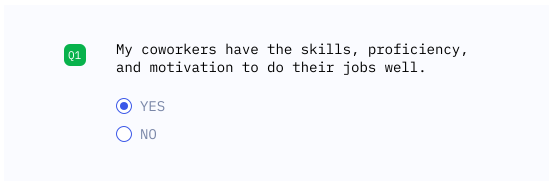
Yes/No
The simplest of all survey questions. Ask a direct question where the expected answer is only two - either a yes or a no.
Best for: a clean binary fact you can act on without nuance.
Example: Do you know who to approach when you have a concern about your workload?
Multiple-choice questions
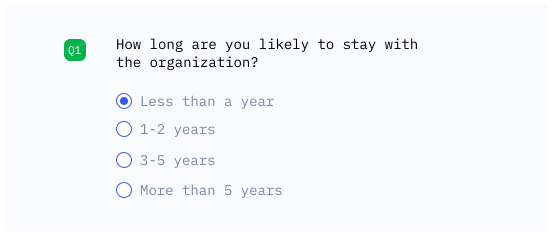
Want to give employees the choice to choose beyond a yes or no answer? This is the type of question you go for if you want to give employees multiple choices to choose from.
Best for: one answer from a known, exhaustive set of options.
Example: How long are you likely to stay with the organization? (Less than a year / 1 to 2 years / 3 to 5 years / More than 5 years)
Checkboxes
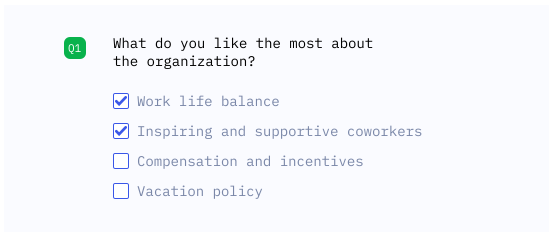
Want to allow your employees to choose more than one answer? Then move to checkboxes from multiple choice.
Best for: several answers at once from a known set of options.
Example: What do you like the most about the organization? (Work life balance / Supportive coworkers / Compensation / Vacation policy)
Ranking scale
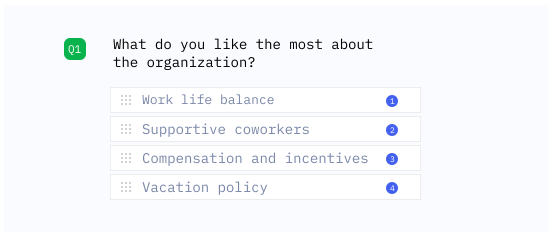
The ranking scale allows respondents to rank the given choices in the order of their preference. This is especially helpful when you need to understand how employees feel about certain aspects of an organization in relation to others.
Best for: forcing a priority order when every option sounds important.
Example: Rank these in the order they matter to you: work life balance, supportive coworkers, compensation, vacation policy.
Rating scale
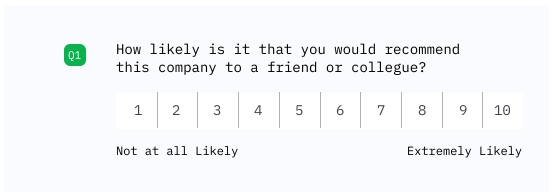
On a scale of 0-10, 0-100 or similar, employees get to choose the number that is closest to their answer. This moves the block from mere black and white - yes or no answers - to more nuanced answers.
Rating scales are most popularly used to identify employee net promoter score (eNPS) - how likely an employee is to recommend the company to friends or family. eNPS always uses a 0 to 10 scale.
Best for: a 0 to 10 measure, which is how eNPS is asked.
Example: How likely is it that you would recommend this company to a friend or colleague? (0 to 10)
Likert scale
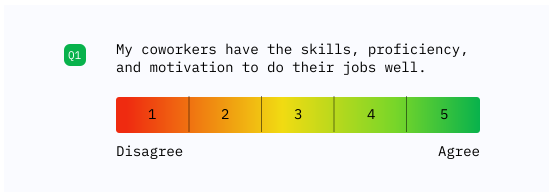
One of the most preferred choices for employee survey questions, the Likert scale - a type of rating scale - gives employees a range of options to give specific feedback. These scales run from strongly disagree to strongly agree.
Best for: agreement with a statement, on one consistent five-point scale.
Example: My manager gives me useful feedback on my work. (strongly disagree to strongly agree)
Text Box
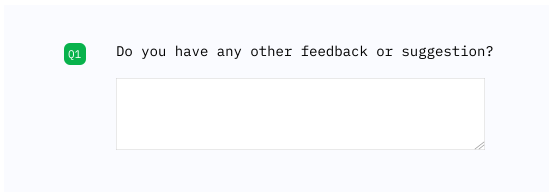
A blank space when you want your employees to give elaborate answers that go beyond the options you can give. This is often used when you want to gather additional information.
Best for: the why behind a score, when you have the capacity to read every answer.
Example: What is the one thing you would change about how we work?
Keep it short and concise.
Both your survey questions and the employee survey itself.
There are so many different types of employee survey questions you can ask but if you create a survey with an endless number of questions, your employees will never get to the last question, compromising on the quality of insights. Moreover, you’ll be washed away by a flash flood of unnecessary permutations and combinations of data.
Of course, if there are big ideas that you want to explore, break them down into smaller questions.
For instance, if you want to understand if employees are satisfied with the recognition they get, you might want to ask two questions: one about the frequency of recognition, and one about the type of recognition. This way, there will be more clarity in the answers.
But at the same time, don’t forget your audience. To get positive, faster, and guaranteed responses from them, keep your surveys short and concise including your questions.
What questions to ask in an employee survey?
Ask about the drivers you actually intend to act on. CultureMonkey scores fifteen, and a focused engagement survey usually covers eight to ten of them rather than all fifteen, because every extra question costs response rate.
We tend to use terms such as employee satisfaction, motivation, engagement metrics, and culture very loosely.
The truth is, they aren’t all one and the same thing!
In that sense, conducting employee engagement surveys, employee satisfaction surveys, employee experience surveys, and culture surveys can’t be the same either - they do not measure the same outcomes!
We would highly recommend not falling for a survey just because it is called one of the above.
Rather, depending on what you hope to measure and improve using your employee survey, the meaning of your survey changes. Let your survey objective - what you want to learn from the employee survey - be the cornerstone for your journey.
Pro tip: Do not start by naming your employee survey as satisfaction, motivation, wellbeing, culture, or engagement survey, instead define your objective and find questions that help you achieve that objective. If you are hiring a consultant or an employee survey platform to do the job for you, convey your objective to them and how they can help you meet your end goal. On the other hand, if you are planning to run the survey on your own, let your objective and what you hope to learn from the survey guide you to the right questions. What you need are validated and reliable questions that measure employee engagement aspects that you want insights about; an effort that will go awry if you simply pick and choose employee survey questions from one of those many random lists on the internet.
Choose any employee survey and you’ll ideally be measuring employees’ perception, behavior, and attitude towards an organization across 15 drivers, in varying capacities. These 15 drivers have, time and again, emerged in research as consistent factors with a direct impact on productivity, commitment, and loyalty to an organization.
CultureMonkey’s fifteen engagement drivers are the set this guide is organised around, and the set the platform scores against. The methodology page explains how each one is calculated, including the five-point scale and the score arithmetic behind it.
- Rewards
- Recognition
- Autonomy
- Work Life Balance
- Work Environment
- Management
- Leadership
- Innovation
- Involvement
- Growth & Development
- Social Connection
- Purpose Alignment
- Meaningful Work
- Communication
- Wellness
What each driver actually scores
A driver score only means something next to a comparison. These are what the same fifteen drivers score across CultureMonkey’s benchmark data, on the same 0 to 10 scale, alongside how closely each one moves with eNPS.
| Driver | Score (0 to 10) | Moves with eNPS |
|---|---|---|
| Purpose Alignment | 8.43 | Strong |
| Social Connection | 8.40 | Moderate |
| Meaningful Work | 8.24 | Strong |
| Autonomy | 8.23 | Moderate |
| Management | 8.23 | Moderate |
| Innovation | 8.17 | Moderate |
| Work Environment | 8.14 | Moderate |
| Leadership | 8.04 | Moderate |
| Involvement | 8.04 | Strong |
| Communication | 7.95 | Strong |
| Growth & Development | 7.91 | Strong |
| Wellness | 7.87 | Moderate |
| Recognition | 7.68 | Moderate |
| Work Life Balance | 7.66 | Moderate |
| Rewards | 7.13 | Moderate |
Source: CultureMonkey employee engagement driver benchmarks, Q2 2026 edition, updated August 2026. Across all 22 drivers CultureMonkey tracks, the median score is 8.09, and the range runs from 7.13 to 8.93.
Read the two columns together, because they answer different questions. Purpose Alignment and Social Connection already score near the top of the range, so asking more about them usually confirms what you know. Rewards, Work Life Balance and Recognition sit at the bottom. And Growth & Development, Communication and Involvement move most closely with eNPS while still scoring below the driver median, which makes them the most useful things to ask about.
If you are cutting fifteen drivers down to the eight or ten a focused survey can carry, that last group is where to spend the questions.
To make choosing or writing employee survey questions easier for you, we have listed four questions for each of these 15 drivers, 60 in all. Choose the ones that are relevant to your survey’s objective and to what you want to learn.
Employee Survey Questions on Rewards
Rewards are basic to an employer-employee relationship.
For the efforts and commitment your staff demonstrates at work, they naturally expect direct returns.
These tangible and intangible returns include their salary, bonus, monetary rewards, and additional perks - stock options, unlimited leave policies, and more.
But here’s something you need to know.
Yes, money matters to the extent where employees feel a basic level of job satisfaction and fairness. Post that, engagement is largely dependent on the other 14 factors defined here.

- Do you feel fairly rewarded for your contribution at work?
- Are you satisfied with the benefits your organization provides beyond salary?
- Do you have a clear understanding of what you can do to see an increased reward for your work?
- Do you feel that employee rewards are handled fairly in your organization?
Employee Survey Questions on Recognition
People want to feel supported and appreciated at work.
It is an important factor that encourages people to do more and be more.
When measuring engagement or employee satisfaction at your organization, it is crucial to understand whether employees feel valued at work.
And when it comes to building your culture, establish the practice of recognizing behaviors that you want to be part of your culture. For example, client centricity, integrity, innovation, etc.
The more you recognize the right behavior, the more it will become enmeshed within your culture.
- Have you felt appreciated at work in the last 30 days?
- Do you feel like you are a valued member of the team?
- Is the recognition that you get from your manager meaningful enough?
- How well does your team celebrate successes and achievements?
Employee Survey Questions on Autonomy
Autonomy means giving employees the agency to do their work well.
Of course, not all organizations can have the same level of autonomy.
While some may be able to give flexible work timing, others might be able to give only the freedom to do the work in the way the employee chooses but within a specified deadline.
Whatever autonomy looks like for an organization, there are two counterproductive traits to autonomy - micromanagement and control - that all organizations must steer clear of.
- Do you decide how your own work gets done?
- Do you have the flexibility to do your work well?
- Do you set the pace and order of your own work without needing sign-off?
- Do you have the freedom to put your best foot forward?
Employee Survey Questions on Work Life Balance
Sometimes an overworking employee can look like an engaged one. But that may not be true.
A lack of work life balance will only push the employee to the edge of disengagement and burnout.
Rather, a fully engaged and productive employee is one who feels they are not making compromises in their personal or professional lives.
Especially with the Millennials and Gen Zs, work life balance is a crucial determinant of loyalty and employee retention.
- Do you often have to compromise on your personal life to meet your professional commitments?
- Do you have enough energy after work to do the things you need to?
- Are you satisfied with the flexibility and accommodations provided for personal needs?
- How supported do you feel by your manager in balancing your work and personal life?
Employee Survey Questions on Work Environment
The physical workspace, and who employees share it with, has a significant effect on how productive and motivated they feel.
And not just an aesthetically appealing workspace but a safe one is also important.
Ultimately, you want your employees to be at their productive best. And if their work environment is a hindrance to it, then you’ll definitely want to do something about it.
- Do you feel you have access to the resources and tools necessary to perform your job effectively?
- Do you think your work environment enables you to be more productive?
- Do you find your work environment safe?
- Do you think your work environment is inclusive?
Employee Survey Questions on Management
A manager-employee relationship lies at the heart of engagement.
A direct manager can greatly influence an employee’s perception and attitude towards work and the organization.
We all have had experiences where we chose to stay or quit an organization because of a manager.
Do we need to say more?
- Does your manager advocate for your team’s needs within the organization?
- How effective is your manager in resolving conflicts within the team?
- How often do you receive constructive feedback on your performance?
- Do you think your manager treats everyone on the team equally?
Employee Survey Questions on Leadership
Trust in the leadership equates to trust in the organization.
And trust is built in small moments - when leadership communicates effectively with employees, is visible and seen often, acknowledges other employees, cares for the people, and demonstrates the capability to scale the company culture.
- Do you trust what the leadership has to say?
- Do leaders consider the impact of their decisions on employees?
- Do you believe senior leadership demonstrates integrity and ethical behavior?
- Do you believe the organization is well-positioned for future success?
Employee Survey Questions on Innovation
Companies grow when they constantly innovate. And employees feel engaged when they are able to explore, ideate, and grow.
However, most organizations - with time - fall into a rhythm where there could be a resistance to change. This directly stands in the way of innovation.
- Are employees encouraged to try new ideas at your organization?
- Are you afraid of the consequences if you make a mistake at work?
- Is ‘we have always done things this way’ a hurdle in your team?
- How confident are you in the organization’s ability to adapt to industry changes?
Employee Survey Questions on Involvement
Who wouldn’t want to be fully involved in the work that they do - especially if it is challenging, and the environment they work in is supportive.
And the more involved the employees are, the more passionate they will be about their work and thereby, happier and more engaged.
- Is it easy to get work done in this organization?
- Do you get to do challenging work here?
- Do people work well together in this organization?
- Are you involved in decisions that impact your work?
Employee Survey Questions on Growth & Development
Employees want to work for an employer that will upgrade their skills, give them opportunities to grow professionally and climb the ladder of success.
When employees do not see the possibility for professional growth and development within an organization, it causes disengagement, and eventually, they will quit the organization for a better opportunity.
- Do you feel that you are growing professionally?
- Do you feel your job allows you to develop new skills?
- Are you satisfied with the opportunities to grow in this organization?
- Has anyone in the last six months spoken to you about your professional growth?
Employee Survey Questions on Social Connection
You cannot take the human side out of people. We are social animals, at work and outside.
Employees who are able to build even a single bond of friendship within the organization are believed to stay with the organization for longer.
Employees’ social connections are a strong indicator of employee engagement and thereby, retention within the organization.
- Do you feel comfortable asking your colleagues for help?
- Do you have at least one person who you can call a friend at work?
- Do you feel a sense of belonging with the people you work with?
- Do people on your team look out for one another?
Employee Survey Questions on Purpose Alignment
What motivates people to truly wake up in the morning and come to work is when they have a view of the larger picture - how their efforts are contributing to the success of the company.
When employees know the impact of their work, they are committed to working harder and connecting more emotionally with the vision of the organization.
- Do you feel aligned with the company’s mission?
- Are you aware of how your work contributes to the company’s success?
- How satisfied are you with the alignment between your personal values and the company’s mission and values?
- Are you aware of the vision of the organization?
Employee Survey Questions on Meaningful Work
Meaningful work means how much value an employee gives his/her work.
Based on various factors that are often very personal, employees either find their work meaningful or not.
And if they find their work meaningful, they are bound to engage and contribute more.
- Do you feel like your work is creating an impact?
- Do you find your job challenging?
- Do you feel the work you do is worth doing?
- How well do your current job responsibilities align with your skills and career aspirations?
Employee Survey Questions on Communication
Any relation is as good as the communication between the people involved.
In an organization, the ease and quality of inter-team, intra-team, top-bottom, and bottom-up honest communication defines an employee’s ability to voice their opinions and be heard; which, in turn, impacts and boosts employee engagement.
- How well does the organization communicate changes that affect your work?
- Are team meetings productive and efficient?
- Do you find it easy to share your thoughts and opinions in this organization?
- Is your manager open to the ideas you raise?
Employee Survey Questions on Wellness
Employees want to know that the organization cares for them as individuals.
Beyond just resources that deliver results, when organizations show empathy towards employees, it translates into engagement.
And the best way for an organization to care for employees is by focusing on their wellness.
- Do you feel your organization is concerned about every employee’s wellbeing?
- Do you find stress manageable at work?
- Are you aware of the wellness programs your organization offers?
- Do you often feel very tired at work?
Which employee survey template should you use?
Pick the template that matches your objective: satisfaction for a quick read on mood, engagement for a full read across the drivers, culture for values and behaviours, wellbeing, manager effectiveness, or new hire experience. Each one is a starting point, so delete the questions that do not serve your objective before you send it.
Every template below is readable in full on this page, and each links through to employee survey templates you can load and edit directly.
| Survey type | When to use it | Questions | Recommended scale |
|---|---|---|---|
| Employee satisfaction | A quick read on overall mood, once or twice a year | 7 | 1 to 10 rating, plus one 0 to 10 eNPS item |
| Employee engagement | A full read across the drivers, annually or twice a year | 27 | Five-point agreement, plus two 0 to 10 rating items |
| Workplace culture | When you are assessing the values and behaviours people actually experience | 27 | Five-point agreement |
| Employee wellbeing | When wellbeing is a named priority or a known risk | 7 | Five-point agreement |
| Manager effectiveness | When you are building a manager development programme | 20 | Five-point agreement, plus two open text items |
| Employee experience | At onboarding and through the first 90 days | 9 | Five-point agreement |
Employee satisfaction survey
Employee satisfaction survey questions are a quick dip-stick to gauge how content your employees are at work. This employee survey will let you know the overall mood of the organization, that is, what percentage of employees are satisfied at work and how many are not.
The insights you derive from your employee satisfaction survey will help you understand if your employees are willing to wake up every morning and come to work and that they are not actively looking out for another job.
Pretty much scratching the surface of understanding an employee, we would say.
The last question below is eNPS. It uses a 0 to 10 scale rather than the 1 to 10 scale of the others, and it is scored separately from the engagement score that it never feeds into.
For something to read your result against, the median employee Net Promoter Score in CultureMonkey's eNPS benchmarks is +27 on the −100 to +100 scale, which sits in the good zone, and the top quartile starts at +44.
Sample Employee Satisfaction Survey Template
- On a scale of 1-10, how happy are you to come to work?
- On a scale of 1-10, how would you rate your company culture?
- On a scale of 1-10, how satisfied are you with your working relationship with colleagues?
- On a scale of 1-10, how happy are you with your direct manager?
- On a scale of 1-10, how much do you like the work that you do here?
- On a scale of 1-10, how satisfied are you with your work life balance?
- On a scale of 0-10, how likely are you to recommend your workplace to friends or family? (eNPS)
Employee engagement survey
If you want to delve a little deeper into what is working and not working at your organization, then an employee engagement survey is your best bet.
Employee engagement survey questions usually touch upon all 15 drivers and unearth insights on how much an employee feels motivated to go above and beyond the call of duty at work. An engaged employee does not just do the work but is also constantly thinking of the organization as their own and looking for means to improve and enhance operations.
Actively engaged employees are the best an organization can ever ask for.
But to truly engage employees, you should constantly keep a tab on the 15 factors that directly impact engagement.
The first 25 are agreement statements on a five-point scale. The last two are rating-scale questions about retention intent, so score them separately rather than folding them into the same average.
Sample Employee Engagement Survey Template
- I feel fairly rewarded for my contribution at work.
- I find stress manageable at work.
- I know what is expected of me at work.
- I have the freedom to do my job well.
- I feel like my work is creating an impact.
- It is easy to get work done in this organization.
- I have at least one person who I can call a friend at work.
- I have been appreciated at least once in the last 30 days.
- I believe that the leadership can take the organization to new heights.
- I am encouraged to share new ideas in this organization.
- My work environment helps me be productive.
- I am able to balance my personal and professional commitments.
- My organization regularly shares company updates with us.
- I am happy with the relationship I share with my manager.
- I am aware of how my work contributes to the company’s success.
- I have access to resources to do my job well.
- I find my job challenging.
- I am satisfied with the opportunities to grow here.
- I feel comfortable asking my colleagues for help.
- My organization is concerned for my well-being.
- I feel like a valued member of my team.
- Someone has spoken to me about my career progression in the last 60 days.
- The leadership is transparent in its internal communication.
- I am involved in decisions that impact my work.
- My manager trusts me to do good work without looking over my shoulder.
- How likely are you to stay with the organization in the next 1-3 years?
- How optimistic are you about your future with the organization?
Employee survey on culture
Culture is what makes you a dream company to work for.
A great culture attracts top talent like bees to nectar.
Workplace culture is the sum total of all the organizational values and beliefs that shape the attitude and behaviors of employees at an organization.
When you are looking to assess and improve the defining factors of your organizational culture is when you should run this survey. For a shorter, more focused version, see our workplace culture survey guide.
Note: roughly a third of this template overlaps with the engagement template above. Run one or the other, not both in the same cycle.
Sample Organizational Culture Survey Template
- People from all backgrounds are treated fairly at my organization.
- The work environment here helps me be more productive.
- I know what behaviors are valued here.
- I am provided with the tools and resources to do my work well.
- I feel like a valued member of the organization.
- The leadership is capable of taking the organization to success.
- There is a strong emphasis on employee well-being.
- My levels of stress feel manageable.
- It is easy to get work done here.
- My manager respects me as an individual.
- I think my manager is the right fit for the role.
- I’m fairly rewarded for my contribution at work.
- We are regularly updated about the organization’s progress.
- I don’t have to compromise on other things that are important to me to meet work deadlines.
- I’m aware of the career growth opportunities in the organization.
- People work well together in this organization.
- Employee complaints are effectively handled.
- Employees are encouraged to try new ideas to improve business.
- Everyone here is mostly aware of what drives our success as an organization.
- I feel confident that my organization can handle change effectively.
- I know how my work adds value to the organization.
- I am satisfied with the opportunities to share my opinions.
- I am at ease when I’m around others at work, regardless of their title, position, or stature.
- I’m satisfied with the career progression I get here.
- I will recommend my company to my friends and family.
- Do you feel comfortable expressing your opinions and ideas without fear of negative consequences?
- Are you confident that mistakes are handled constructively and not held against you?
Employee wellbeing survey
Employee wellbeing is now a standing item on most HR agendas.
Employee wellbeing is mainly about reducing work-related stress and instituting incentives for healthy living. The focus here is on the physical, psychological, and mental health of an employee.
Keep these questions about what the organization does, not about the employee’s own health. A survey that asks employees to rate their personal fitness measures the wrong party and creates a privacy problem you do not want.
Sample Wellbeing Survey Template
- My organization is concerned about employee wellbeing.
- I feel well supported by my manager at all times.
- Our leaders consider the impact of their decisions on employees.
- Senior leaders communicate with us often enough.
- I feel confident that my team will support me through any crisis.
- I am able to effectively manage both my personal and professional commitments.
- I am aware of the wellbeing programs my organization offers.
Manager effectiveness survey
Managers are the microcosm of an organization.
Employees don’t often quit the organization, they quit their managers.
Therefore, managers’ effectiveness as people leaders is of utmost importance to organizations. If you are building a development programme off the back of it, pair this with our manager development guidance.
The last two are open text prompts, not scale items.
Manager Effectiveness Survey Template
- I have been appreciated by my manager at least once in the last 30 days.
- I feel like a valued member of the team.
- My manager sets reasonable deadlines.
- I have enough freedom to do my job well.
- My manager proactively discusses my career goals.
- My manager directs me to learning opportunities at work.
- My manager communicates what is expected of me in this role.
- My manager offers constructive feedback on my work.
- My manager treats everyone on the team fairly.
- My manager involves me in decisions that directly impact my work.
- I know my manager has the expertise to lead the team.
- I feel comfortable reaching out to my manager for help.
- New ideas are welcomed by my manager.
- I feel confident to take risks at work as I have my manager’s support.
- My manager recognizes the importance of my personal and family life.
- My workload is reasonable for my role.
- My manager shares the organization’s larger goals with the team.
- My manager sets clear goals for the team.
- My manager should continue…
- My manager should stop…
Employee experience survey
Unlike engagement, culture, or satisfaction surveys, employee experience surveys gauge an employee’s experience at a specific point in their journey.
The template below covers onboarding and the first 90 days only. It is a new hire survey, not a full lifecycle instrument. Exit and long-tenure questions are a separate piece of work.
For the wider set of touchpoints, from day 30 through to exit, see employee lifecycle surveys. For a deeper set of first-week questions, see our onboarding survey questions.
New Hire Experience Survey Template
- The goals of my onboarding have been clear.
- I have been informed about what is expected of me.
- I understand this organization’s policies.
- I have been provided with the resources needed to do my job.
- My manager has been supportive throughout the onboarding journey.
- My job responsibilities are what I expected them to be.
- I understand this company’s values.
- I feel comfortable reaching out to my coworkers for help.
- The training I have received so far has been effective.
When should you use a pulse survey instead?
Use a pulse survey when you need to track a small number of things often. Ask four or five questions at most, keep the wording identical every cycle, and show a visible action between cycles or your response rate will fall.
If you are worried about survey fatigue that comes with long-form surveys, or you want to track progress consistently and in real time, then a pulse survey is the shorter instrument to reach for.
Pulse surveys are when you either:
- Ask not more than 4-5 questions repeatedly over regular intervals to gauge progress in certain areas
- Ask short and fewer questions to get instant feedback on a recent policy change, merger, and the like
What changes at pulse cadence is question design, not question quality: fewer questions, the same wording every cycle, and a visible action between cycles. Our pulse surveys guide covers cadence in full, and the pulse survey tool page covers running them. For the score itself, see employee pulse score.
What mistakes should you avoid in employee survey questions?
Five wording mistakes account for most unusable survey data: jargon, leading questions, double-barreled questions, incomplete answer options, and too many open-ended questions. Each has a fix you can apply to a draft in minutes.
These are not house opinions. The Pew Research Center’s guidance on writing survey questions (Pew Research Center, accessed September 2026) names the same failure modes, including double-barreled questions, which it defines as questions that ask respondents to evaluate more than one concept at a time. The American Association for Public Opinion Research’s Best Practices for Survey Research (AAPOR, accessed September 2026) set the wider standard for question wording and survey design.
Using industry jargon
 Using industry jargon
Do you have the bandwidth to do all of the tasks assigned to you?,
vs.
Do you have enough time to complete all the tasks assigned to you?
Simplify questions to make them easy for employees to understand
Ultimately, how well employees understand a question is how well they will answer it.
Any misunderstanding can skew your survey data and insights in the wrong direction.
Writing leading questions
“Don’t you think your manager is supportive at work?”
A question like this already puts an answer in the employee’s mouth, completely negating the point of writing employee survey questions.
Instead ask:
“Is your manager supportive at work?”
This question encourages an honest response. Instead, if your question already has an implied answer, your staff is going to feel coerced into agreeing with what you say.
Remember to read through your employee survey questions again to ensure you haven’t accidentally put in a leading question.
Including double-barreled questions
Any question that introduces more than one issue will make it difficult for employees to give the right answer.
For example,
“Do you feel that your organization has a great work culture with supportive leadership?”
This question actually asks two things:
If the work culture is great.
And, if the leadership team is supportive.
Ask these questions as two separate questions. Clubbing the two will confuse employees and give you inaccurate data to work with.
Incomplete employee survey questions
Ensure the answer options are exhaustive and include all possible choices for employees.
Just in case, you are not able to predict all answers or are unsure, add an open field as ‘other’ for employees to add in their response if it is any different from the options available.
Asking too many open-ended questions
Always remember, while employees would love to see their feedback valued and being acted on, they would still not place as much value and importance on it as you do.
Let’s accept this: filling an employee survey will always be secondary to their work commitments and even personal plans.
So keep these employee surveys as short and crisp as possible.
And one way to do that is by avoiding the overuse of open-ended questions.
Use open-ended questions only when you think you need more information about a certain driver or aspect.
Overdo it and it’ll result in survey fatigue and low response rates.
What else do people ask about employee survey questions?
- What are good employee survey questions?
- A good employee survey question measures one thing, uses plain language, and does not suggest an answer. It ties back to something you intend to act on, and it is worded identically each cycle so the score means something over time. If you cannot say what you would do with the answer, cut the question.
- How many questions should an employee survey have?
- Fewer than you think. A focused engagement survey covers eight to ten of the fifteen drivers rather than all fifteen. A targeted pulse might use just two or three. Every question you add costs response rate, so add a question only when you can say what you would do with the answer. Cut anything you will not act on.
- How often should you run an employee survey?
- Most organizations run a full engagement survey once or twice a year, with shorter pulse surveys in between. The right cadence is the one you can act on. Surveying more often than you can close the loop on feedback erodes trust and pushes response rates down on the next round, which costs you more than the extra data gains.
- Should employee surveys be anonymous?
- Anonymous surveys get more honest answers on the questions people find risky to answer, which is usually manager, leadership and fairness. Anonymity thresholds apply before any cut of the data is shown, so a small team's scores roll up rather than being exposed. If employees do not believe the anonymity holds, the scores you get are not worth reading.
- What is the best scale for employee survey questions?
- A five-point scale, used consistently. Point 1 is most negative and point 5 most positive: 4 and 5 count favorable, 3 neutral, 1 and 2 unfavorable. CultureMonkey ships eight preset label sets plus a smiley display. Custom label text and reverse-coded questions are not supported. eNPS is the exception, on its own 0 to 10 scale.
- What is the difference between engagement and satisfaction survey questions?
- Satisfaction questions ask whether employees are content with pay, conditions and workload. Engagement questions ask whether they are invested enough to contribute beyond what the job demands. A satisfied employee may still do the minimum. Satisfaction is a useful dip-stick and is faster to run, but engagement is the one that tells you whether people will go beyond the minimum.
How do you put your employee survey questions to work?
The questions decide what you learn. The four weeks after the results land decide whether anyone answers honestly next time.
Your employee survey is only as good as the survey questions you ask. If you don’t get the start right, then the rest of your effort is bound to fall like a pack of cards.
But the questions are only half the job. Employees judge a survey programme by what happens after it, not by how well it was worded. A cycle that closes with a visible decision earns you the next round of honest answers. A cycle that closes in silence costs you the response rate you worked for.
There is nothing that will increase employee engagement faster than asking employees what they think, but equally nothing will destroy that trust more quickly than asking for that feedback and then doing nothing with it.
 Gethin NadinChief Advisory Officer, BenifexCultureClubX, season 7 episode 1
So plan the four weeks after the results land before you send a single question. Decide who reads the results, which two or three driver scores you will act on, what you will tell employees you are changing, and when you will tell them. Our guide to reading employee survey results covers how to get from driver scores to a shortlist of actions.
And on the other hand, running an employee survey entirely on your own is tedious, to say the least. Imagine putting in all that manual effort to write questions, aggregate data, analyze the results, present the results to leadership, and then drive an action plan around it.