


What is a pulse survey?
A complete guide to assessing the pulse of your organization
A pulse survey is a short, recurring employee survey that asks a few questions on a regular schedule, such as weekly, every two weeks, or monthly. It gives HR teams and managers a current read on engagement and morale between annual surveys, so they can spot issues early and act quickly.



Key takeaways
- A pulse survey is short and recurring. It supplements your annual engagement survey, it does not replace it.
- In CultureMonkey, exactly one question goes to each employee per cycle, drawn from a curated bank and rotated across engagement drivers.
- Three cadences are supported: every week, every two weeks, or every month.
- One question per cycle is the design, not a limitation. It is what keeps participation high enough to build a trend.
- Survey only as fast as you can act.
When feedback only arrives once a year, it arrives late. Long annual surveys lose people's attention, results take weeks to reach the managers who could act on them, and by the time anything changes the moment has passed.
That gap is the problem a pulse survey exists to close. Short, repeating check-ins sit between your annual engagement surveys and keep the feedback loop alive, so you find out that something has shifted while you can still do something about it.

Only 8% of employees strongly agree that their organization takes action on surveys. Gallup, 2023. Still the most recent figure Gallup has published on this measure. Read the research
Pulse surveys have become the fast-growing option for continuous listening, alongside annual engagement surveys and life cycle surveys, because they collect short and frequent feedback without asking much of anyone.
This guide covers what a pulse survey is, where the method came from, how it compares with an annual survey, how to run one well, and what to look for in pulse survey software.


What is an employee pulse survey?
A pulse survey trades depth for frequency. Rather than one long questionnaire a year, it asks very little and asks it often, so you can watch engagement move instead of photographing it once.
The questions are short and pointed, covering areas such as recognition, work life balance, management support or workload, and they repeat on a schedule: weekly, every two weeks, or monthly. Because each round asks so little, employees can answer in seconds, which is what keeps participation high enough for the trend to mean anything. Feedback can be collected anonymously, so people answer honestly.
But, mind you, a good employee pulse survey is not just about turning long surveys into fragmented little surveys. Employee pulse surveys are usually a set of questions that are asked repeatedly over a period of time to measure progress in a certain area, or are quick ways to collect feedback on any change within the organization. If you want the fuller case for running one, see the purpose of a pulse survey.
A pulse survey will tick all the right boxes for you in terms of getting frequent feedback from your employees, higher actionable responses for the survey, and more honest participation.
But, here's the catch. No staff pulse survey can be of help to any organization unless the employee feedback is acted on. Collecting employee feedback and generating engagement reports are not enough. You have to start acting on the feedback and communicate the same with employees. Nothing short of this can instill trust among employees towards the leadership.
In short, the real key to the success of a pulse survey mechanism is how you convert employee feedback into dialogues that influence action and deliver quantifiable business outcomes.

Where did employee pulse surveys come from?

Pulse surveys feel modern, but the practice of asking employees how they feel and acting on the answer is more than a century old. Understanding where it came from is useful when you are pitching a pulse programme internally: this is established practice, not a trend.
The method has its roots in the years around World War I, was formalised in industry through the 1920s as the “employee attitude survey”, and has been refined ever since.
During World War I, industrial leaders were concerned about the attitude of their employees, which was driving labour strikes and resource shortages during wartime. In response, leaders had to come up with a scientific approach to workforce management. The period is documented in the research literature on employee attitude surveys in historical perspective.
Necessity being the mother of invention, a pressing need pushed the leaders of that era to build the first attitude surveys. They asked employees questions about management and coded the responses on a scale of one to five, through agreeable or disagreeable context.
This process helped them formulate an average attitude score that they could use to compare and track engagement levels amongst the employees of various departments. By the 1920s the approach had a name and a following, which is why employee surveying is now well past its hundredth year.
Even though conducting employee surveys back then was way ahead of its time, it had its limitations. Surveys used a paper and pen approach and did not guarantee employees any anonymity. As a result, employees were not confident enough to express unbiased feedback, for fear of negative consequences.
Cut right to the late 1990s and early 2000s. We witnessed the technological era where employee surveys began to be conducted quickly and securely over the internet. Except for moving to a more digital process, there was no significant change in the survey mechanism during this period.
Thanks to cloud-based software, running surveys is easy, less expensive, and readily accessible. Cloud-based platforms have made it possible for organizations to enhance their capabilities when it comes to conducting employee surveys and have enabled them to measure trends and the pulse of their employees more frequently.
That is where the pulse survey sits today: as one instrument inside a continuous listening approach. Continuous listening treats feedback as an ongoing conversation rather than an annual event. A deep survey once or twice a year sets the agenda, a pulse tracks whether the things you are working on are actually moving, and lifecycle surveys catch the moments that matter to an individual. The pulse is the part that keeps the conversation running between the others.
One conclusion to the evolution of employee surveys is this: across time, there has always been a need for behavioral science practices to improve how engaged people feel at work, even as we probably lacked the tools to fully make it happen.
It is safe to also assume that getting feedback from employees is not a recent trend. Instead, it has been at the core of developing a good company culture from the very beginning.

Pulse survey vs annual engagement survey
An annual survey measures every driver once and gives you depth. A pulse asks one question at a time and gives you direction. Finance will ask why you need both: the honest answer is that neither one does the other's job.

Engagement surveys are most widely used by leadership teams to gauge the engagement levels of their employees. By asking employees a series of questions about their employee experience in the organization, action plans are formulated to improve engagement.
And most organizations conduct these engagement surveys annually.

An annual engagement survey usually serves as a year-on-year comparison of the engagement levels of employees. These surveys collect and unearth a lot of valuable data from the entire organization for deeper analysis, which can then be used for goal setting and finding ways to improve employee satisfaction, work culture, and company values.
But leaders need to understand that, no matter how good an annual engagement survey is, it is not enough on its own. Engagement surveys that are run annually are nothing but a yearly report. With no real-time information handy, acting on insights from annual surveys is a backward-looking exercise.
Picture a survey that closes in March. You have your insights and a solid action plan for the year. Then in May two departments are merged, a new leadership team arrives, or the return-to-office policy changes. Every one of those lands on your people in a week and reshapes how they feel about work.
Would an action plan built in March still hold by June? By then, the needs of your employees would have changed.
Reorganisations, leadership changes, policy shifts and systems migrations are not rare events. Something in that list happens to most organizations every year, and a lot changes over 365 days: your employees' engagement levels, loyalty to the organization, motivation to work, and more.

So how exactly does a pulse survey differ from an annual survey?
Pulse surveys are more frequent, more specific, and much shorter, which gives you a current read on your employees' engagement levels without causing survey fatigue.
They let you ask about what is happening right now and watch the answer move over time. That timeliness can help you gauge the mood after an appraisal season, gather views on a recent policy change, or check how a new way of working is landing.
This aspect of the pulse survey provides a level of transparency that would never be achievable with an annual survey alone.
The insights from regular pulse surveys help managers resolve an issue then and there, without letting it grow into a larger problem such as a cause for attrition. It is this aspect of the pulse survey that makes it widely popular in leadership circles.
| Pulse survey | Annual engagement survey | |
|---|---|---|
| Number of questions | One per employee, per cycle | Many, across every engagement driver |
| Time to complete | Seconds | 10 to 20 minutes |
| Frequency | Every week, every two weeks, or every month | Once or twice a year |
| Quality of data collected | Yes | Yes |
| Real-time data analysis | Yes | No |
| Immediate actionability | Yes | No |
| Tracking of workplace trends | Yes | Yes |
| Depth of insight | No | Yes |
| Best used for | Tracking which way engagement is moving between surveys | A deep, segmentable diagnostic you can plan against |
What are the benefits of pulse surveys?
Pulse surveys give you a current read instead of a yearly one, and they do it without the participation cost of a long form. That combination is what makes continuous listening sustainable.
If you are writing the business case, the number to put in it is this: low engagement cost the world economy approximately $10 trillion in lost employee productivity, or 9% of GDP, in 2025 (Gallup, State of the Global Workplace: 2026 Report). As of May 2026, just 26% of U.S. employees feel their opinions count at work (Gallup Employee Engagement Indicator, 2026). Here is what a pulse adds, and our cluster page on the benefits of pulse surveys goes deeper on each one:


Real-time insight
 Real-time insight
You find out that sentiment has shifted in the next cycle rather than in next year's report.
Higher participation
 Higher participation
People will answer one short question far more readily than commit to a long form, so response rates hold up over time.
Less survey fatigue
 Less survey fatigue
Asking one thing at a time keeps the ask small, which is what makes a recurring programme sustainable.
Faster action
 Faster action
A short, current signal is easier to act on than a 60-page annual report, so the gap between hearing and doing gets shorter.
Trend tracking by driver
 Trend tracking by driver
Because questions rotate across engagement drivers, you build a movement line for each one instead of a single yearly number.
Change-readiness checks
 Change-readiness checks
When a reorg, a policy change or a migration lands, a running pulse tells you how it was received while you can still adjust.
Running a pulse survey is simple. If you have access to any decent employee engagement software, running a pulse survey and collecting data from your employees is straightforward.
But that's only the beginning of the exercise.
The data needs to then be crunched and reports need to be generated.
And if the reports generated from the employee data don't reach the managers and leaders in time, then this whole exercise might turn into a negative experience for employees, as they see no action being taken on the feedback they shared.
Oftentimes, carefully investing in reliable technology is the first and right step you need to take. When it comes to pulse survey software, it is important to buy one that can analyze the data and create reports at speed, helping you act faster.


How to launch your pulse survey
Four steps: choose a cadence you can act on, let the tool pick and rotate the questions, read the trend rather than the single score, and put every insight on a board with an owner and a date.


Collating questions, collecting data about the recipients, and putting up Google Forms to run pulse surveys for your employees sounds the least bit fun, right? Especially if you have to do it alongside the million other things that need your attention right now.
The next best bet is outsourcing it to a consultant. Unfortunately, their process would not be much different. The same old Google Forms and time-consuming manual processing will not give you magical results, except take that workload off your table.
If you ask us, we would suggest you invest in an enterprise survey platform or a dedicated pulse survey tool.
For instance, CultureMonkey is an employee engagement platform built to help you listen to, analyze and act on employee feedback.
Unlike other pulse survey tools or methods that take hours, days, and weeks of your time in setting up the process, CultureMonkey runs the pulse for you: you choose a cadence, and it handles question selection, scheduling and dispatch from there.
Let's quickly walk you through how to launch your first pulse survey.
Step 1: Choose your pulse survey frequency
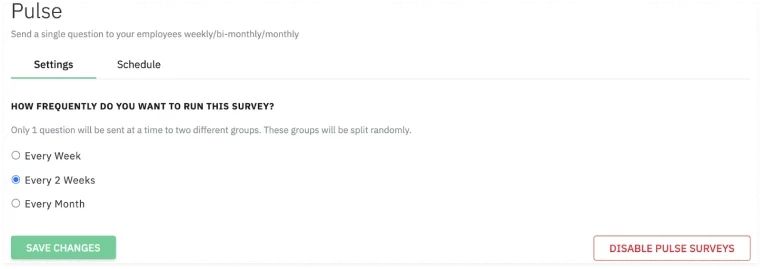
Frequency is the single most important choice you make, and in CultureMonkey it is essentially the only setup decision. There are three options: Every Week (7 days), Every 2 Weeks (14 days), and Every Month (28 days). By default a new pulse starts on the next occurring Wednesday and questions go out at 10:00 AM in your account timezone.
Every two weeks is a sensible starting point for most teams: frequent enough to build a real trend, light enough to keep going indefinitely. Weekly gives you the fastest signal but asks the most of your people. Monthly is a gentler touch for larger organizations.
The real constraint is not what you can send. It is what you can act on between sends. Gallup's own published guidance is semiannual engagement surveys with quarterly to monthly pulses (Gallup, Employee Surveys That Drive Performance, 2026). Pick a cadence you can genuinely respond to: a monthly pulse you act on beats a weekly pulse you ignore. It is also the more honest read on survey fatigue, which is usually less about being asked too often than about being asked and then ignored.
CultureMonkey tip
You can disable a pulse at any time. Disabling stops all future sends and cancels any runs that were queued. Responses already collected stay in your pulse reports, and you can re-enable the pulse later to pick the rhythm back up.
Changing the frequency of a running pulse cancels the pending questions in the current cycle and generates a fresh schedule on the new rhythm. That is expected, but it is worth doing deliberately rather than repeatedly.
I've got a lot of friends in the survey community who talk about the fact that it's actually just inaction fatigue. If I've told you five times that this is broken and you've never done anything about it, I'm going to stop telling you.
 Alexis FinkPeople Analytics Leader, formerly Meta, Microsoft, IntelCultureClub X, Season 6: The Future of Work with AI
Step 2: Pick your pulse survey questions
Pulse surveys are about asking one thing at a time, powerful enough to tell you what you need to know.
The common failure is scope creep. There are so many good survey questions available that it is easy to keep adding them, and more often than not what was meant to be a quick pulse swells into something that looks like an annual survey.
In CultureMonkey you do not hand-build a pulse questionnaire, which removes that risk entirely. Exactly one question is sent to each employee per cycle, drawn automatically from a curated pulse question bank. Each question in that bank is mapped to an engagement driver, and the rotation is balanced across drivers, so you cover a broad range of themes over a quarter while only ever showing one question at a time.
On each run, employees are split into two random halves so coverage stays fresh across the population rather than always leaning on the same people. Nobody receives more than one question in a cycle.
CultureMonkey tip
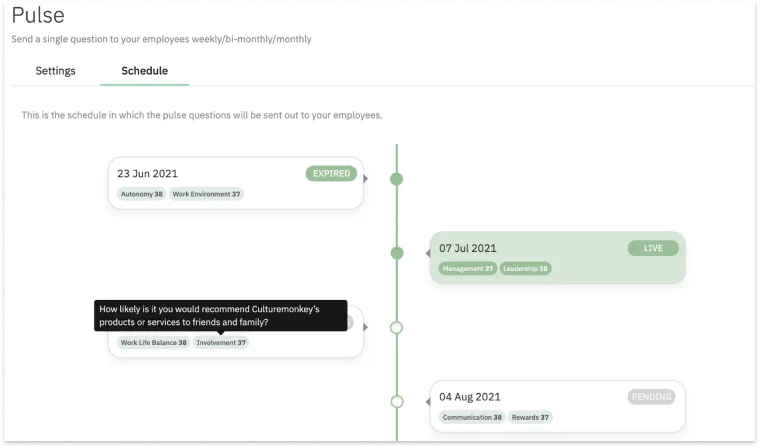
The rotation also seeds the eNPS question, so your advocacy signal stays current alongside the driver questions without you scheduling it separately.
The Schedule tab visualizes the whole pulse timeline: each dated run, the driver it measures, and, for live and completed runs, how many employees it reached.
What are examples of pulse survey questions?
When you only get one question per cycle, the choice is not how many to ask but which engagement driver you are reading this week. Each example below is labelled with the driver it measures.
- RecognitionI receive meaningful recognition for the work I do.
- ManagementMy manager gives me the support I need to do my job well.
- Work Life BalanceI am able to maintain a healthy balance between work and my personal life.
- Growth & DevelopmentI have opportunities to grow my skills in this organization.
- CommunicationInformation I need to do my job reaches me in good time.
- AutonomyI have the freedom to decide how I do my work.
- LeadershipI trust the decisions our senior leaders make.
- Purpose AlignmentI understand how my work contributes to our organization's goals.
- Work EnvironmentI have the tools and resources I need to do my job well.
- WellnessMy workload is manageable.
Every one of these measures a single construct, avoids leading language, and fits a five-point agreement scale, which is what lets you compare the score across cycles. For more examples, see our pulse survey questions roundup. For the full method behind writing and wording them, read the guide to employee survey questions.

Step 3: Analyze pulse survey results
This is where most pulse programmes quietly die. The results land as a spreadsheet nobody can interpret, the momentum goes with it, and cycle three never happens.
Survey responses are loads of information and numbers that take you nowhere unless someone can make meaning of them. If you want reports that are readable without an analyst sitting between you and the data, that is what a pulse tool should give you.
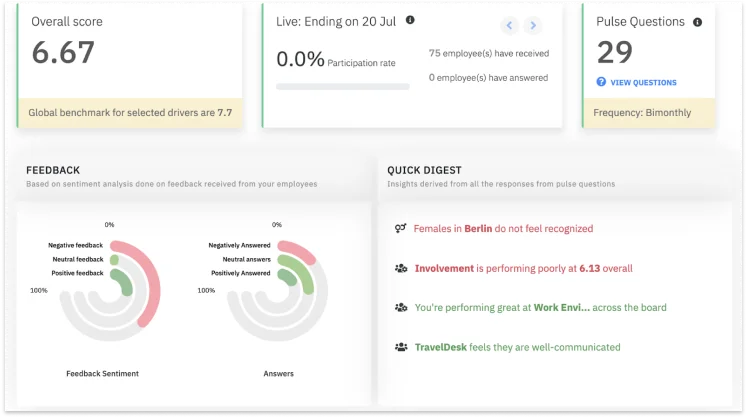
Pulse has its own dedicated report, separate from your survey reports, and built around movement over time: an engagement score with a delta against the previous pulse, driver performance, per-question scores, and pulse feedback with sentiment. Worth knowing before you go looking for it: pulse results do not appear in your regular survey reports, because the two are organized around different questions.
Open-text responses are read by context-aware AI. Comments are analyzed against the question that was actually asked, and each one is broken into topics with sentiment and emotion tagged per topic, which makes the result materially more useful than a generic positive-negative-neutral score.
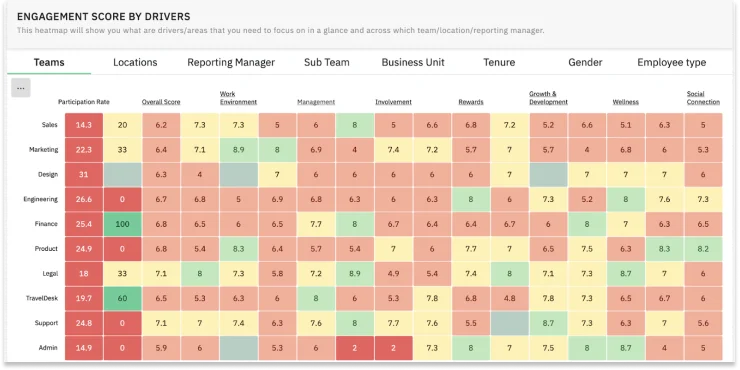
Participation is tracked per run: the rate is employees who answered divided by employees who received, times 100, shown on cards for the previous, live and next run. Behind the reports, response rates roll up by month and can be broken down by team, manager or location, so a dip shows up as both a lower bar and thinner data behind the score.
Anonymity thresholds apply throughout. A group's scores stay hidden until enough people have answered, so no individual's response can be inferred from a narrow filter.
How does your pulse score compare?
A pulse score means something next to two things: your own previous cycle, and everybody else. Your pulse report gives you the first. Benchmarks give you the second.
Across CultureMonkey’s benchmark dataset (Q2 2026 Edition, spanning 18 industries, 5 regions and 4 company-size tiers from 2021 Q3 to 2026 Q2), the median engagement score is 8.10 on the 0-10 scale and the median eNPS is +27 on the −100..+100 scale.
0-10 scale
−100..+100 scale
Here is where a score lands. Read your own number against the column that matches it, and remember that a pulse engagement score and an eNPS are two different scales that never convert into one another.
| Where a score sits | Engagement (0-10) | eNPS (−100..+100) |
|---|---|---|
| Top 10% | 8.71 and above | +56 and above |
| Top quartile | 8.44 and above | +44 and above |
| Median | 8.10 | +27 |
| Bottom quartile | 7.75 and below | +12 and below |
eNPS is calculated as % Promoters (9-10) − % Detractors (0-6). Full cuts by industry, region and company size are in CultureMonkey’s employee engagement benchmarks, and you can place your own figure against them with the percentile comparison tool.
Which driver to read first
This is the question a pulse actually forces on you. One question per cycle means you are choosing a driver every time. The benchmark data ranks which drivers move most closely with employee advocacy, so if you are deciding where to point your first few cycles, start at the top of this list.
- Growth & Developmentscores 7.91 on the 0-10 scale
- Communicationscores 7.95 on the 0-10 scale
- Meaningful Workscores 8.24 on the 0-10 scale
- Purpose Alignmentscores 8.43 on the 0-10 scale
- Involvementscores 8.04 on the 0-10 scale
- Work Environmentscores 8.14 on the 0-10 scale
The gap between those two things is where the work usually is. In CultureMonkey’s Q2 2026 Edition benchmarks, Growth & Development moves advocacy more than any other driver yet scores 7.91, below the median. The three lowest-scoring drivers of the 22 CultureMonkey tracks are Rewards at 7.13, Work-Life Balance at 7.66 and Recognition at 7.68, all on the 0-10 scale. The full table is in the driver impact rankings, and advocacy on its own is broken out in the eNPS benchmarks.
One caution before you quote any of this to leadership: a benchmark tells you where you stand, not what to do. A score below the median is a prompt to look, not a verdict. Your own trend across cycles is still the more useful number, which is why the pulse exists at all. If you want the cut closest to your own organisation, start with engagement by industry.
Step 4: Act on the feedback
No matter how good the reporting is, if you cannot convert insight into action then running the pulse survey was pointless. This is also the step that decides whether cycle two has any response rate left.
It bears repeating, because the research is blunt about it: only 8% of employees strongly agree that their organization takes action on surveys (Gallup, 2023, still the most recent figure Gallup has published on this measure). Acting on feedback is not the easy part of this process. It is the part almost nobody does.
That is why you need software that makes employee feedback management easier.
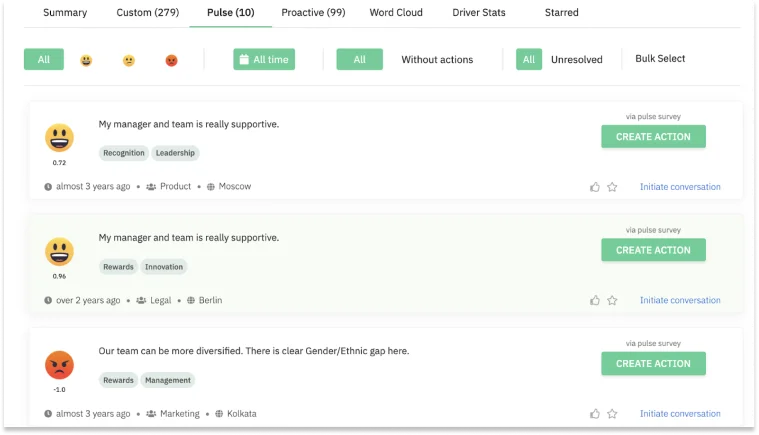
CultureMonkey gives you an overview of the responses received, so you can read feedback on the dashboard and create actions against it straight away.
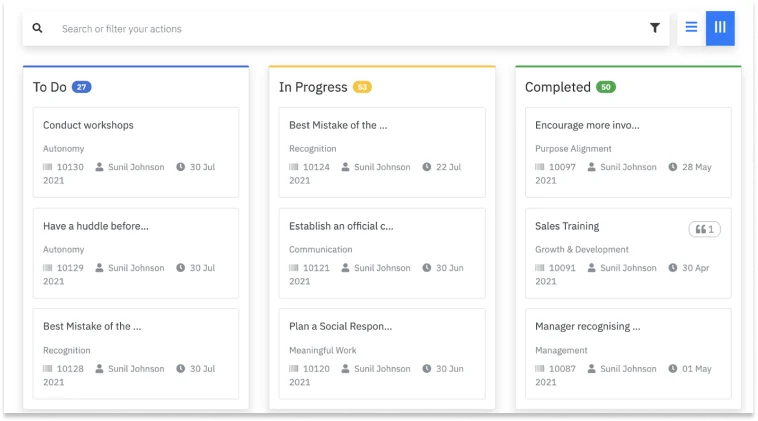
Actions live on a Kanban board with five status columns: To Do, On Hold, In Progress, Cancelled and Completed. Each column header carries a live count, and every card shows the driver it serves, its owner and its deadline, so the board stays scannable when it holds dozens of items. You move work forward by dragging cards between columns.
Closing the loop is what protects your next cycle. Reminders lift a single run; visibly acting on what the pulse surfaces, and telling people you did, lifts every run after it.
If you're doing pulse surveys, I'd suggest publishing the results in some way, maybe even the bad and the ugly, giving people a sense of the tone, and here's what we're doing to address it, and we think next time we'll see better scores.
 Catherine MatticeFounder and CEO, Civility PartnersCultureClub X, Season 6: The Trust KPI Playbook

What are the best practices for pulse surveys?
Most pulse programmes do not fail at launch. They decay, usually because the cadence outran the organization's ability to respond. These seven practices are the parts that break.
Pulse surveys, used correctly, are a leadership tool rather than just another survey. Here are the practices worth following, whether you use a tool for it or not:

Don’t replace annual engagement survey with a pulse survey

Don't replace the existing annual engagement survey with a pulse survey.
There might be many best practices to keep in mind while running pulse surveys. Out of them, the first and foremost practice is to always use pulse surveys as a supplement to annual engagement surveys.
Even though annual surveys are long, one should not discontinue running them. That yearly read on overall performance across the drivers of engagement is equally important.
These responses will help you analyze trends and themes over time and will help you see the bigger picture while planning your engagement strategy.

Make surveys mobile friendly

A large share of your workforce will answer on a phone, and some of them have no desk at all. Make sure your pulse renders properly on a small screen so people can respond on the go, anytime and on any device.
Reach matters as much as rendering. CultureMonkey pulse surveys are delivered by email. If you need to reach frontline teams who do not use email at work, the platform separately supports SMS, WhatsApp, QR codes and kiosk mode for surveys.

Announce the survey and set clear objectives

The first thing to do while launching a pulse survey is to announce and promote it internally. Tell people what it is, how often it will arrive, and what it will get them. A short heads-up sets expectations and lifts early participation.
Secondly, make the objective clear. There is no point running a pulse survey for the sake of it if you do not have a solid view of what to do with the data collected.
That's why you need clarity about what you want to measure, what you are going to do with the results, and how soon you could resolve your employees' issues.

Get feedback anonymously
Be it any kind of survey you run, anonymity in surveys is always of paramount importance.
The very fact that you keep the survey anonymous will improve your response rates, as it instills trust amongst your employees to provide honest feedback.
Not only that, anonymous surveys help in gathering constructive feedback, act as a basis for discussion, and more importantly, give equal rights to your employees to provide feedback, no matter where they are in the hierarchy of the organization.

Choose relevant survey questions
The aim of a pulse survey is to keep the ask as small as possible, in the number of questions and in the length of each one.
Hold the line at one question per employee per cycle. That is how CultureMonkey's pulse works, and it is the discipline worth keeping whatever tool you use. When you only get to ask one thing, the real decision is which engagement driver you are reading this cycle, not how many questions you can fit.
Gallup makes the same point from the other direction: globally, only one in four employees strongly agree their opinions count at work (Gallup, 2023, still the most recent figure Gallup has published on this measure). Treat every question like it costs something, because it does.

Analyze the survey responses
Once you have completed running the survey, you would have lots of responses to make sense of.
Now, it's essential for you to review all the responses in detail without any bias, look for areas that need improvement, and reflect on positive changes.
You would need a pulse survey tool that could pull deep-insight reporting to analyze the trends and the results, so you can take the necessary actions on the feedback received. Our guide to reading pulse survey metrics covers how to get from a score to a shortlist.

Focus on resolving the feedback at a faster rate
Survey only as fast as you can act. While scheduling a pulse survey, you need to be mindful of what timeline you have set to resolve or take action on your employees' responses.
That's because if you're collecting feedback and doing nothing with the data and insights it provides, you're sending the wrong message to your employees, that you don't value their time, which in turn can make the whole process lose its value.
Acknowledge employee feedback while solving it, and that gesture would make your employees believe that you care about their problems.
How to choose the right pulse survey software?
Score vendors on seven things: setup effort, customizability, anonymity and reach, report readability, what managers get, how actions are managed, and the support behind it.
Enough said about pulse surveys and their best practices. Let's now talk about what to look for when choosing pulse survey software, because the right tool makes it easy to send surveys as part of your internal communication strategy and helps build a strong culture of feedback.
Here are seven elements to keep in mind when choosing the right pulse survey platform for your organization. If you are mid-evaluation, our roundup of pulse survey tools compares the main options against these criteria. The wider market is covered in our guide to engagement survey tools, and you can put two products side by side on features and pricing.


Easy to set up
Being an HR leader for an organization of any size is not an easy job. You have to deal with lots of high-impact tasks and you may not possibly have enough time to set and curate employee surveys from scratch.
That is why you must invest in a pulse survey tool:

- That has a great UI/UX
- Lets you easily schedule a pulse survey using readily available pulse survey questions
- Runs pulse surveys in an automated way with minimal intervention
 That has a great UI/UX
Customizability
While choosing any feedback tool, you need to be sure that it offers customization to its existing features based on your needs, because no matter how good it is, if its features don't fit your requirements, the tool won't do much good for you.

Customization here could mean anything that meets your requirements, such as the ability to adapt reporting, segment results the way your organization is actually structured, or deliver surveys in the languages your workforce reads.
Anonymity and reachability
The first checkbox to click before running any survey is anonymity. Anonymity drives better participation because your employees feel safe coming forward with nothing but the truth as their feedback.

Ask the vendor how anonymity is actually enforced, not whether they claim it. In CultureMonkey, identities are masked and a group's scores stay hidden until it reaches the anonymity threshold, which defaults to five people and can never be set below three. A pulse needs at least five active employees before it will run at all, and exit and onboarding are the only survey types that can be set to identified.
Reachability is the other half. You drive better response rates by making surveys easy to answer and accessible across the channels your people actually use, including SMS, email, WhatsApp, Slack and Microsoft Teams.
Easily consumable reports
When you choose a pulse survey software, one fact you have to know is that the software is as good as the reporting it offers. The quicker you have access to the pulse survey data, the faster you can act.

By fast data, we don't mean the sophisticated, good-looking dashboards where one can't comprehend anything at all. Instead, the tool should present a comprehensive report that's easily consumable and insightful enough to let you start drafting actions right away.
Also, if the reports are easily exportable, that is an added advantage, as it makes it easier to present and track progress with your leadership team.
Personalization for managers
Individual managers are equally responsible for maintaining the company culture and improving the employee experience. That's why the pulse survey software must be user-friendly for managers too, so that they can actively participate in collecting, analyzing, and acting on employee feedback.

More importantly, offering additional features for managers like a personalized dashboard to gauge their performance as a leader will further enable them to set engagement targets and achieve them for the benefit of the organization.
Effortless feedback management
Find a technology that makes feedback management easier for you, because the easier the feedback management part is, the quicker you can focus on taking action on the feedback received.

And when it comes to taking action, look for a tool that gives you somewhere to put the work: an action board with owners, deadlines and clear statuses, and a library of pre-built actions you can start from rather than drafting every plan from a blank page. Our roundup of employee feedback tools covers how the main platforms handle this stage.
Dedicated tech support
Always look for software that offers continuous support for you to set things up. Adapting to a new platform takes time, but the process can be simplified with the support of a good Customer Success team. Never miss checking on the support and assistance that your chosen vendor provides.

Especially, look for an employee engagement vendor who considers your organization's increased engagement as their win and helps you navigate any bumps in the road in a friendly manner. If you are still drawing up a shortlist, we have compared the vendors worth putting on it.
Pulse survey FAQs
- What is a pulse survey in simple words?
- A pulse survey is a short employee survey that repeats on a schedule instead of arriving once a year. It asks very little, often a single question, so it takes seconds to answer. Run often enough, it shows you how engagement is moving rather than where it stood on one day.
- How often should you run a pulse survey?
- CultureMonkey supports three cadences: every week, every two weeks, or every month. Every two weeks suits most teams. Gallup's own guidance is semiannual engagement surveys with quarterly to monthly pulses. The honest test is not what you can send, it is how quickly you can read the results and act on them.
- How many questions should a pulse survey have?
- One. In CultureMonkey, exactly one question is sent per employee per cycle, drawn automatically from a curated bank and rotated across engagement drivers so coverage builds over time. The eNPS question is seeded into that rotation. Asking more per cycle turns a pulse back into the annual survey it was meant to relieve.
- What is the difference between a pulse survey and an engagement survey?
- An engagement survey measures every driver at once and gives you a deep, segmentable report you can plan against for months. A pulse asks one question per cycle and gives you a trend line. The annual survey tells you where you stand. The pulse tells you which way you are moving.
- Are pulse surveys anonymous?
- In CultureMonkey, yes. Identities are masked, and a group's scores stay hidden until it reaches the anonymity threshold, which defaults to five people and can never be set below three. That floor is what lets people at every level and background answer honestly. Exit and onboarding surveys are the only identified types.
- What is a good pulse survey response rate?
- Participation is employees who answered divided by employees who received, times 100. CultureMonkey's Help Center guidance is that many teams see 60% or more on a healthy weekly pulse and strong programmes pass 75%. Reaching people in the language and channel they actually use helps. Acting visibly on their feedback helps more.
Where should you start with pulse surveys?
You now know what a pulse survey is, how it differs from an annual survey, how often to run one, and what separates a pulse programme that lasts from one that fades after three cycles and builds a great work culture.
If you are planning the first ninety days: run your full engagement survey to set the agenda, turn on a pulse at every two weeks to track whether the things you picked are moving, and decide before you send anything who reads the results, which two or three drivers you will act on, and when you will tell employees what changed.
Low engagement cost the world economy approximately $10 trillion in lost productivity, or 9% of GDP, in 2025 (Gallup, State of the Global Workplace: 2026 Report, 2026). The pulse is not the point. What you do between pulses is.