


What is employee engagement?
Employee engagement is the emotional and practical commitment employees feel toward their work, team, and organization. Engaged employees understand their role, believe in the company’s goals, and choose to put in extra effort. It is shaped by the job itself, the team, the manager, and what the organization offers.
Further down this guide we build on Alan Saks’ research to set out CultureMonkey’s own definition of engagement, which frames it as a two-way mutual commitment between an organization and its people.
Key takeaways
- Employee engagement is the emotional and practical commitment an employee feels toward their work, their team, and their organization.
- Engagement is not satisfaction: a satisfied employee is content, while an engaged employee is invested enough to go beyond the job description.
- Four categories drive it: how an employee sees their job role, their connection with the team, their interaction with the manager, and what the organization offers.
- Engagement sits on a spectrum from actively disengaged to highly engaged, rather than being a yes or no state.
- It is measured by surveying those drivers, then tracking an engagement score, eNPS, participation rate, and driver-level scores over time.

Where employee engagement stands today
- Only 20% of employees globally are engaged at work. Gallup, State of the Global Workplace: 2026 Report
- “Eighty percent of employees worldwide are still not engaged or are actively disengaged at work.” Gallup puts the split at 64% not engaged and 16% actively disengaged. Gallup, how to improve engagement in the workplace, 2026
- Low engagement cost the world economy approximately $10 trillion in lost employee productivity, or 9% of GDP. Gallup, global engagement continues to decline, 2026

- Figures like these have made engagement a standing item on every HR agenda, but they rarely explain what engagement actually is, what those numbers are measuring, or which lever moves them.
- This guide sets out the definition, the drivers, and the levels of engagement, then covers how to measure and improve it, so you can build an employee engagement strategy guided by both academic and market research.

Why is there no single definition of employee engagement?
Engagement became a mainstream research topic only two to three decades ago, so researchers, consultancies and software vendors each arrived at their own wording. Rather than adopting one vendor’s definition wholesale, standardise internally on the themes every definition shares, then state engagement in terms your leadership team can actually act on.
- And that’s because employee engagement is a multi-faceted psychological construct that became mainstream only about two-three decades ago.
- As a result, most organizational psychologists, researchers, HR consulting firms, and SaaS employee engagement platforms follow varied definitions of engagement.
Engaged employees are those who are involved in, enthusiastic about and committed to their work and workplace.
The level of an employee's psychological investment in their organization.
The emotional commitment that we have to our organization and the organization’s goals.
The harnessing of organization members' selves to their work roles; in engagement, people employ and express themselves physically, cognitively, and emotionally during role performances.
A distinct and unique construct consisting of cognitive, emotional, and behavioral components that are associated with individual role performance.
A fundamental concept in the effort to understand and describe, both qualitatively and quantitatively, the nature of the relationship between an organization and its engaged employees.

- There are almost as many definitions of employee engagement as there are of HR consulting firms and thought leaders!
- It is interesting to note, however, that even in these myriad definitions are some underlying themes that are common to all of them.
- Let’s take a closer look.

Defining employee engagement holistically

Social Exchange Theory
Social exchange theory suggests that we essentially take the benefits and subtract the costs in order to determine how much a relationship is worth. Positive relationships are those in which the benefits outweigh the costs, while negative relationships occur when the costs are greater than the benefits.
- Engagement refers to an attitude or behavior of the employee that demonstrates their investment in the organization
- It defines the relationship between a satisfied employee and the organization

Building a little more on Saks’ theory, we define employee engagement as:
“The two-way mutual commitment between an organization and its engaged employees, where there is a healthy give and take that leaves both parties benefitted from the interaction.”
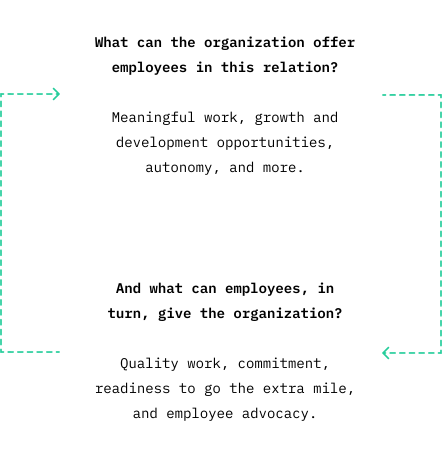
A Three-step Instant Employee Engagement Check
“Say”: Are your employees speaking positively about your organization to co-workers, customers and others?
“Stay”: Do they have a strong desire to be part of the organization?
“Strive”: Do they show readiness to put in discretionary effort without expectation of monetary rewards?

Why do engagement levels vary between employees?
Because engagement depends on what each employee actually receives and how they read it, not on what the organization offers on paper. Two people reporting to the same manager, on the same benefits, can score very differently based on personality, past experience, expectations, and what they need at that point in their career.
- You might wonder if an organization is giving similar resources and support to its employees, why then is the engagement levels among employees so varied.
- One reason is that within the same organization itself, the opportunities, resources, and support each employee has access to vary.
“There has to be a deep-seated desire in your heart and mind to participate, to be involved, and to make a difference. If the desire isn’t there, no person or book can plant it within you.”Tim Clark
- And the other reason that often tends to get overlooked is the individual differences in perception. Every person makes sense of their environment, interprets and responds to people and situations around them in their unique way. This could be a result of their personality, past experiences, knowledge, expectations, priorities, and interests.
- For instance, Steve and Renu both have flexible working hours. Steve effectively utilizes this opportunity to balance his personal interests and professional life, and the organization observes a boost in his engagement. On the flip side, Renu prefers stricter timelines, and the flexibility cripples her time management skills, leaving her working extra long hours. As a result, Renu is often frustrated and less engaged.Similarly, Maria loves the autonomy that her manager gives her to make decisions that impact her work. However, Ali perceives this as a lack of interest from his manager’s side to guide him. Quite obviously, you know who is engaged and who isn’t!

- Based on the above, it is safe to conclude that workplace engagement is not an objective understanding of what an organization is offering its employees. It will also be subject to individual differences. However, it is important to note here that research has shown that there are certain consistent factors that drive engagement among all workers, which we’ll discuss soon.
Hire for culture fit.
Bring on board people with similar personalities, qualities and behavioral traits that suit the company culture you want at your workplace.
While hard skills such as experience and skill sets are important, an organization’s ability to retain and get the best from an employee depends on how aligned the employee feels with the organization.
For instance, an organization that relies heavily on individual initiative and independent tasks may not be a cultural fit for someone who works more effectively in collaborative teams.
Or, an employee who values flexible work timing may not be a good fit in a team that works around strict timelines.
As a rough guideline, base about 75% of your hiring decision on skills and experience and the remaining 25% on cultural fit. Treat that split as a working guideline rather than a researched ratio: the point is that culture fit should be a deliberate part of the decision, not the whole of it. Once someone joins, your 30-60-90 day onboarding plan is where that fit either takes hold or does not.
What employee engagement is not

Engagement gets used interchangeably with satisfaction, motivation, experience, happiness and wellbeing, and each of those is a different thing with a different fix. The distinction matters at board level, because a satisfaction problem and an engagement problem call for very different interventions.
| Term | What it means | How it relates to engagement |
|---|---|---|
| Employee satisfaction | Whether an employee is content with the job, the pay, the workload and the conditions. | Satisfaction asks whether an employee is content. Engagement asks whether they are invested enough to give effort the job description does not require. Engaged employees are usually satisfied, but a satisfied workforce is not automatically engaged, and it is the most common conflation at board level. |
| Employee motivation | Whatever drives a person to act in a certain way to reach a goal. | A driver of behaviour, not of commitment. Fear of a manager motivates, and it never engages. |
| Employee experience | Every touchpoint across the employee life cycle, from tools and policies to facilities. | The input. Engagement is the output an organization gets when the experience is good. |
| Employee happiness | An intrinsic state of being that an employee largely chooses. | Pleasant and contagious, but it guarantees none of the commitment or effort engagement describes. |
| Employee wellbeing | Physical, mental and psychological health, and the reduction of work-related stress. | An enabler. Poor wellbeing reliably suppresses engagement, while good wellbeing raises the ceiling on it. |
Employee satisfaction
Simply put, engaged employees are satisfied with their jobs, but satisfied employees aren't necessarily engaged at work.
What does this mean?
It means the two are measuring different things. Satisfaction asks whether an employee is content with their job, their pay and their working conditions, and a content employee is a good thing to have. Engagement asks a harder question: whether that employee is invested enough to put in effort nobody has asked them for.
However, here’s where employee satisfaction falls short of engagement.
Satisfied employees won’t necessarily align with the larger purpose of the organization's success, innovate new products or services, help co-workers, etc., which are all evident behavioral traits of an engaged employee.
Employee motivation
Motivation is anything that drives an individual to act in a certain way to achieve a specific goal.
Recognition from the manager is a motivator, and so is fear of the manager. Both will get employees to complete their work effectively and on time.
However, an employee who is motivated to work out of fear of their manager won’t be engaged.
Employee experience
A term that rose to popularity not more than a few years ago, employee experience (EX) refers to every touchpoint in an employee’s life cycle that defines their experience with the company. This includes the facilities, the IT infrastructure, the policies, etc., that define an employee’s day-to-day experience.
Now how is employee experience different from employee engagement?
Employee experience can be looked at more as the input and engagement as the resultant output. The more an organization invests in creating a better employee experience, the better will also be employee engagement.
Employee happiness
Happiness is an intrinsic state of being. No matter what an individual’s external circumstance is, an employee can choose to be happy or not.
Happy employees are great for a workplace because happiness is infectious. However, a happy employee does not guarantee loyalty, commitment, innovative spirit, or enthusiasm toward their work, which are pillars of the employee engagement strategy.
Engagement is not driven by happiness. It is driven by success.
 Jamie NotterSpeaker, author and culture scientistCultureClubX, season 6, episode 20
Employee wellbeing
Employee well-being is mainly about reducing work-related stress and instituting incentives for healthy living. The focus here is on the physical, mental health, and psychological health of an employee.
In terms of employee engagement and well-being, well-being can be considered as a factor that can enhance engagement.
For example, some employers run meditation and yoga classes through the working week, and wellbeing platforms have long attached monetary incentives to healthy habits. The Virgin Pulse programme, since rebranded as Personify Health, was an early and widely copied version of this.
In short, all of these terms, in some form, contribute to employee engagement, and engagement in itself can be seen as a larger umbrella concept that encompasses all of the above.
What are the key drivers of employee engagement?

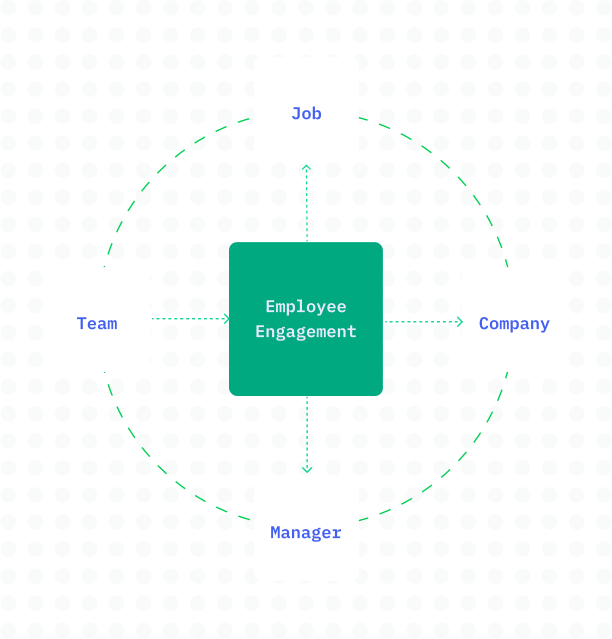
Engagement is driven by four things: how an employee sees their job role, their connection with team members, their interaction with their manager, and what the organization offers. An overall score tells you where you stand, and driver-level scores tell you which of the four to work on first.
Emotions inform an individual’s behavior and actions. “How one feels about one's work” will determine “how one responds to it”. When organizations are able to drive positive emotions like pride, involvement, etc., among their employees, then they are able to be more open-minded, think flexibly, deal with confrontations more thoughtfully and be less defensive at the workplace, all of which enhance employee engagement.
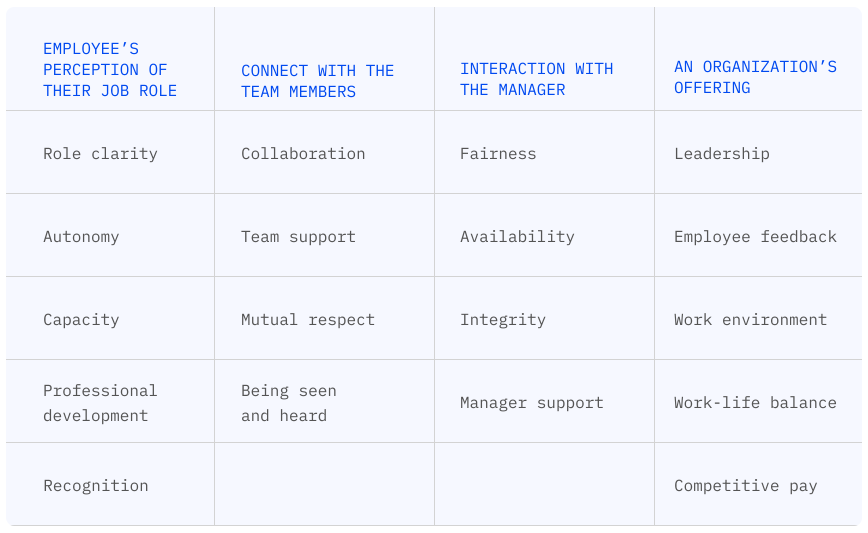
In the two-way relationship between an employer and employee that leads to engagement, there are certain drivers that research has, time and again, demonstrated to impact employee engagement. These drivers fall under four categories:
- An employee’s perception of their job role
- Connect with the team members
- Interaction with the manager
- An organization’s offering
For most of them, it can be summed up by one of four things: They love what they do (their JOB), they love the Disney brand (their ORGANIZATION), they love their manager (their BOSS), or they love the people they work with (their SQUAD).Pete Blank, Employee Engagement Thought Leader

An employee’s perception of their job role

- Do your employees love what they do?
- Loving one’s job does not necessarily have to be a utopian concept. In fact, Kahn’s research on employee engagement and that of his successors show "finding meaning in one’s job" as a primary contributor to employee engagement.
- Now the question is, what drives meaning in one’s job?

Role clarity: When employees have clarity on what their jobs entail, they are able to carry out their day-to-day tasks with confidence and with full knowledge of how their work impacts business. A job description is a great recruiting tool but often does not deliver the kind of job clarity an employee seeks. Job clarity is an ongoing process where the manager can help the employee through any challenges they are facing and also help them align their personal goals with their roles.
Autonomy: Freedom to make decisions that are important to their performance and the quality of their working lives encourages employees to take full ownership of their roles and deliver with commitment. And autonomy can vary based on the type of role an employee is in and the organization's culture. For instance, while some organizations can give employees the autonomy to choose their work hours, others might be able to give them a choice to make decisions in how they execute their work. Let’s say autonomy is also the antithesis of micromanagement.
Capacity: If you want your employees to cut a tree, give them an axe. If you want them to go fishing, give them a fishing rod. No amount of role clarity or autonomy can help if employees do not have easy access to the right resources and tools to carry out their jobs. And in the absence of the capacity needed to carry out their work, employees often take long, winding routes to accomplish tasks that are time-consuming and leave the employees feeling incompetent and discouraged.
Professional development: Every employee has aspirations. To be able to have access to opportunities within the organization that align with their aspirations is critical for employee engagement. Not just that, they also often look for someone, like a manager, to encourage and motivate employees to take advantage of these opportunities. Professional development opportunities include a promotion, training, and learning options.
Recognition: How can an employee know that they are doing a great job at their work? By being recognized for it. However, it is not always necessary that these recognitions come in monetary forms alone. Public recognition from a leader or their manager - words of appreciation - with specific details of the work well done serves as a great opportunity to engage employees.
Autonomy for your blue-collar employees?
In 1990, Julie Beardwell and Tim Claydon conducted research on factory workers and the number of injuries they reported based on differing levels of control over their work.
It was found that, after the staff was given the training and autonomy to make repairs to their own equipment instead of calling the supervisor every time they encountered a problem, they reported fewer occupational injuries.
One can conclude that when workers experience more autonomy over their work -autonomy being a key contributor to employee engagement - they are likely to be more focused and less prone to mistakes.
Connect with the team members

- We are social animals. So be it at work or outside, we constantly keep seeking ways to belong with a group or community.
- A workplace can never be devoid of meaningful relationships.
- And a truly engaged employee will not have to fit in with their team but will feel like they truly belong.
- What’s the difference?
- Fitting in is when employees assess the people and situation and try to shape themselves differently than who they are to be accepted. In the long run, fitting in isn’t sustainable, and employees will eventually become disengaged.
- Whereas belonging is when engaged employees feel like they can be themselves at work and do not have to pretend to be something they are not constantly.
- Factors that drive employees to connect with the team and, thereby, their belongingness are:
Collaboration: How well an employee is able to collaborate with the team demonstrates the safety, trust and camaraderie with the team members. Since employees spend the most time with their team members, an inability to collaborate effectively with the team can be detrimental to employee engagement. For example, if someone feels like other team members are not effectively doing their share of work, it can negatively influence the engagement levels of this employee.
Support: Can employees turn to one or more of their teammates when they need help? Will teammates fill in for each other if one of them is on leave or is dealing with issues that are affecting their productivity? These forms of voluntary support among team members greatly drive employee engagement.
Mutual respect: Can team members also voice disagreement or dissent with ease? A great sign of healthy team engagement and a positive indicator of engagement is when teams make space for healthy arguments and disagreements and can still continue to work towards shared goals.
Being seen and heard: Can employees be themselves around at least one team member? To be able to remove their professional masks and be fully seen for who they are is crucial to building and nurturing strong bonds within a team. This doesn’t necessarily have to be with everyone on the team. Gallup’s Q12 meta-analysis treats having a best friend at work as one of its twelve items, and finds it tracks with stronger engagement outcomes. Gallup Q12 Meta-Analysis, 11th Edition, 2024
Interaction with the manager

- The employee-manager dynamic is critical to measure employee engagement. With managers being an extension of the organization’s leadership team, employees look to their managers not just in terms of team leads who get work done but also as mentors, guides, credible sources of company information, and more.
- We all know the famous saying, “Employees quit managers, not organizations.” The statistics on a manager’s role in engagement validate the impact of managers on an employee’s engagement levels.
- But what factors of this relationship contribute to employee engagement?
Fairness: Employees inevitably compare their situation to that of their coworkers. In those terms, is the manager supportive of everyone equally? Is he/she taking a keen interest in everyone’s work and professional growth? Is he/she giving due credit to each employee? All of these factors that point to the fairness demonstrated by the manager are crucial to employee engagement.
Availability: Can employees reach their manager when it actually matters? This is about whether one-on-ones happen and hold, whether questions get a reply in reasonable time, and whether there is room for the problems that were never on the agenda. A manager who is chronically hard to reach leaves people solving things alone and guessing at priorities, and engagement falls away with it.
Integrity: Does a manager walk the talk? Can a manager lead by example? Do managers’ actions align with their words? The integrity of a manager is primarily gauged by dependability and reliability; if they follow through with what they have said, they will do.
Support: When a manager shows genuine interest in an employee - both professionally and personally, employees feel valued and engaged. Take each of our own personal examples. When have we most felt engaged with an organization? Was it when we had a boss who helped us grow in our careers, gave us the freedom to make decisions, and guided us?
An organization’s offering

- What an organization has to offer an employee is considered the most basic to employee engagement.
Leadership: Trust in leadership is of utmost importance. And trust is built when:
- Business leaders communicate transparently and consistently with the entire organization
- Employees get to see them often
- Leaders demonstrate an interest in employees. Say, personally appreciating an employee or team for a job well done
Employee feedback: Employees want to have a say in decisions that are made in the organization. The opportunity to feed their opinions and views upward is a positive indicator of employee engagement. However, many organizations either fail to give employees such a platform to share their continuous feedback or fail to acknowledge employee feedback, both of which can be equally detrimental to employee engagement.
Work environment: A conducive and safe physical environment is non-negotiable in engaging employees. While some employees, especially in manufacturing, might prioritize safety, others in the creative field might expect a more aesthetically designed workspace. Either way, a positive work environment with good lighting, accessibility features, and decor is bound to improve employee engagement, whereas dangerous, unhealthy, and unappealing office spaces can increase employee disengagement costs.
Work-life balance: Imagine an employee who is spending more than 12-15 hours a day at work? This person is not only going to be exhausted by the end of the day but won’t also have time or energy left to invest in other aspects of their life. As a result, their resentment and frustration will skyrocket, and in effect, their engagement levels will plummet. Charles Duhigg’s definition of productivity resonates very well with the different types of employee engagement, “Getting things done without sacrificing everything we care about along the way.”
Competitive pay: Of course, while competitive salary and benefits are not everything that drives engagement, the absence of it can be disengaging for employees. And in today’s world, competitive pay includes more than just money. It also includes benefits and bonuses that employees will really value. For instance, paid family leave, paternity leave, stock options, paid time off to volunteer, free food and beverages, and more.
As an organization meets more of these drivers, it becomes more attractive to job seekers and more engaging for the staff it already has. For a fuller breakdown of how these group together, see the elements of employee engagement.
What are the levels of employee engagement?
Engagement runs along a spectrum with five recognisable levels, from actively disengaged through to highly engaged. Segmenting your workforce this way is what turns a single score into a plan, because each level needs a different response from HR and from managers.
- Employees fall along that spectrum according to how the drivers of engagement land for each of them.
Disengaged employees: These employees are actively resentful of the organization and are underperformers. They tend to openly criticize the organization, their work, or managers, which can also negatively impact other employees.
- →“I am here for the money”
- →“I am not satisfied with my job.”
- →“I will leave as soon as I can.”
- →“I don’t like the organization or my team.”
- →“I dread coming to the office.”
- →“My eyes are always on the clock.”
Not engaged employees: These employees fulfil their job responsibilities but are neutral about the organization. They mostly work on autopilot and are concerned about their paycheck. These employees will need a clearer reason to engage with the organization actively.
- →“I do what my job description says, and no more.”
- →“I am neutral about this place, honestly.”
- →“I would not recommend working here, but I would not warn anyone off either.”
- →“The work is fine. The company is not really my concern.”
- →“I am here for the paycheck and I log off on time.”
Almost engaged employees: These employees perform well and speak about the organization in broadly positive terms, but one unmet need keeps them from committing fully. It is most often development or recognition: they can name something they want from the organization and have not been given. This is the group most likely to move up a level, because the fix is usually specific and already known to them.
- →“I am happy to work here but won’t shout it from the rooftops.”
- →“I might leave if I’m tempted.”
- →“I am almost engaged, but there are a lot of times when I’m not.”
- →“I think I’m a part of something bigger.”
- →“I don’t know if I have career development opportunities here.”
Engaged employees: These employees give their full at work and feel valued in the organization. They actively take part in decisions that affect their work and share a cordial relationship with team members. They are also very satisfied with the development opportunities they can access within the organization.
- →“I’m an achiever.”
- →“I’m constantly busy, maybe a little overstressed too.”
- →“I may consider a job offer if it comes my way.”
- →“I feel important at work.”
- →“I appreciate the growth & learning opportunities I have here.”
Highly engaged employees: These employees love the work they do and are fully committed to the organization's mission. They bring with them a very positive attitude that is infectious and can positively impact others around them. They have a great sense of pride in the organization and the work that they do and are very vocal about it. In short, they are also your brand ambassadors.
- →“I love working here.”
- →“I am a high flyer.”
- →“I inspire others.”
- →“I proactively help others.”
| Level | What it looks like | What HR should do |
|---|---|---|
| Disengaged | Openly critical of the organization, the work or the manager, and underperforming. The criticism spreads. | Deal with it directly and quickly through the manager. Find the specific grievance before it sets the tone for the team. |
| Not engaged | Doing the job and nothing past it. Neutral about the organization, focused on the paycheck. | The largest group in most organizations and the biggest opportunity. Work on role clarity and on why the work matters. |
| Almost engaged | Performing well and broadly positive, held back by one unmet need, usually development or recognition. | Ask what the unmet need is and close it. The cheapest movement on your score sits in this group. |
| Engaged | Invested in the work, participating in decisions, satisfied with how they are growing. | Protect what is working. Watch workload, because this group absorbs the overflow and burns out quietly. |
| Highly engaged | Committed to the mission, vocal advocates, lifting the people around them. | Give them visibility and a route to influence. Do not quietly tax them with everyone else’s work. |
How to improve employee engagement?

Measure the drivers that actually matter at your organization, then commit to acting on a small number of them and telling employees what changed. A survey that produces no visible action is the fastest way to lose participation on the next round.
There is nothing that will increase employee engagement faster than asking employees what they think, but equally nothing will destroy that trust more quickly than asking for that feedback and then doing nothing with it.
 Gethin NadinChief Advisory Officer, BenifexCultureClubX, season 7, episode 1
Start with effectively measuring employee engagement
- Employee engagement is an outcome of the aforementioned drivers of engagement. One of the easiest ways to measure employee engagement is by measuring the drivers through employee engagement surveys, or through a shorter pulse survey run between full cycles.
- The metrics worth tracking. Your engagement score is the headline number, an aggregate of how employees answered across the drivers. eNPS is the share of promoters minus the share of detractors, and it reads advocacy rather than engagement itself. Participation rate is the share of invited employees who responded, and a falling one usually means the last round produced no visible action. Driver scores break the headline apart so you can see which driver is dragging it down. How the score itself is calculated is set out in our people science methodology, and our guides on measuring engagement go deeper on each metric.
So what is a good score?
A score only means something next to comparable companies. This is how engagement is actually distributed across the organizations benchmarked in CultureMonkey’s own data, on the 0-10 scale. Each company contributes one value, so “top 25%” means the top quartile of peer companies, not of employees.
- Top 10%8.71 and above
- Top 25%8.44 and above
- Median8.10
- Bottom 25%7.75 and below
- Bottom 10%7.38 and below
eNPS sits on its own scale. The median is +27, calculated as % Promoters (9-10) − % Detractors (0-6) on the “how likely are you to recommend this company as a place to work?” question, which runs from −100 to +100. Read it beside the engagement score, never combined with it.
CultureMonkey People Science, Employee Engagement Benchmarks, Q2 2026 Edition, covering 2021 Q3 to 2026 Q2 and refreshed quarterly. You can place your own score in this distribution by industry, region and size band.
- It is important to note, however, that while we discussed all the drivers of engagement in our previous section, not all of them have the same weightage across every organization.
- For instance, a non-profit might give a lot more significance to the meaningfulness of work and leadership over other drivers. Similarly, a project management company will lay emphasis on collaboration and capacity.
- The drivers of engagement that you identify as important for your organization will depend and greatly vary based on the following:
- The organizational culture
- The type of industry
- Type of job
- The personality of your workforce
- To identify the engagement drivers that matter most at your organization, here’s an adaptation of Maslow’s Hierarchy of Needs that will be of help.
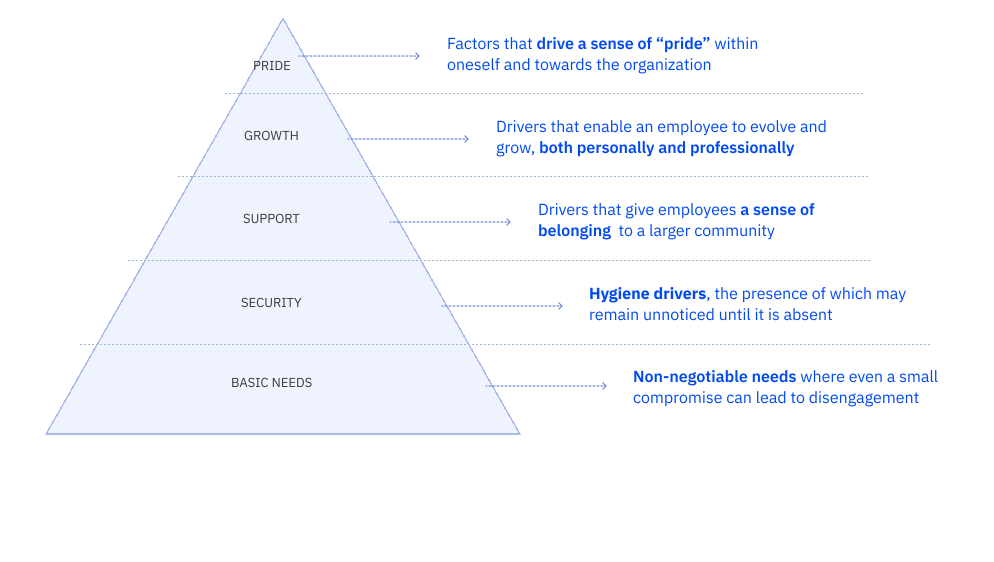
- Using the above pyramid as the foundation, you can categorize the drivers of employee engagement into five segments based on your organization’s culture, industry, type of job, and workforce personality.
- Once you have identified the drivers, write down one or two open-ended or close-ended questions that check the employee satisfaction levels of employees for each of those drivers.
- For example, for the driver work-life balance, you would ask:
- How often do you work beyond your specified working hours?
- Do you have enough time to destress from your work schedule?
- Or, for driver recognition, you might ask:
- Do you feel appreciated at work?
- Were you recognized by your manager for your contribution in the last 30 days?
- Once you have your engagement survey questions ready, administer the survey to your workforce. Our guide to writing employee survey questions covers how to phrase them. Garner maximum participation by communicating clearly with employees and launching across the platforms they can actually reach.
- Alternatively, you could use employee engagement software that will automate end-to-end employee engagement management for the HR department. This software should enable you to identify the drivers of engagement at your workplace, measure employee engagement over time, and suggest action plans to enable you to improve your engagement scores.
- Let’s delve a little deeper into what employee engagement software can do for you.
How does employee engagement software help?

A survey form collects answers. Engagement software turns those answers into driver-level scores, comparisons between segments, and actions with named owners, then tracks whether those actions moved the score on the next cycle.
- In the last decade or two, Artificial Intelligence (AI) and Machine Learning (ML) have reshaped the business landscape. These technological prowesses have enabled organizations to make data-backed decisions, gain unparalleled visibility into operations, and attain better control over the business.
- In the area of employee engagement too, the potential that AI and ML are showing is immense.
- If you have been following an internal process to measure and improve employee engagement, or engaging a third party only to run the surveys, here’s what engagement survey software can do differently for you.
Responsive and real-time feedback: The waiting time between closing a survey and reading the results collapses to a live dashboard that fills as responses arrive, so you can act on what is surfacing rather than waiting on a report. Participation, bounce rate and average response time are tracked alongside it, which tells you quickly whether a launch is landing, including in a hybrid working culture.
AI analysis of open-text feedback: Free-text comments are where the real signal sits, and they are the hardest thing to read at scale. Context-aware sentiment analysis reads each comment against the question that was asked, extracts the topics and aspects raised, and classifies open-text feedback into 15 engagement drivers. That turns thousands of comments into themes with owners, and it surfaces the early signals that usually precede people leaving. It is analysis of what employees are telling you, not a prediction model. An employee engagement toolkit is a reasonable place to start if you are assembling this yourself.
More than just a survey: An employee engagement platform isn’t just about running surveys. A good employee engagement tool will help you slice data and study engagement strengths and pain points across team, location, manager, gender and employee type on a heatmap, and compare a survey against the one before it to see the delta. From there it should auto-suggest actions against the weak drivers and put them in front of the right stakeholders rather than leaving that to a spreadsheet.
Driver analysis: We discussed earlier how drivers of employee engagement could vary from one organization to the other. This means beyond the high and low scores one might get on various drivers of engagement, you must also understand if these drivers actually contribute to engagement at your workplace. For instance, if your organization has been consistently scoring low on “capacity” and no amount of discretionary effort is improving employee engagement score, driver analysis by the employee engagement app can help you identify if capacity is a definitive contributor to employee engagement at your organization.
An AI copilot for the data: AskCooper lets you query employee feedback in plain language rather than building a report to answer each question, and surfaces themes and patterns across open-text responses. It shortens the gap between having the data and knowing what it says.
Action planning and closed-loop feedback: This is the part that decides whether the next survey gets answered. A Kanban action board carries tickets, deadlines and automated owner reminders, AI suggests action plans against the lowest-scoring drivers, and closed-loop feedback lets you react and reply privately to an employee while keeping their anonymity intact. See how action planning works.
Reaching everyone, in their own language: Surveys run in 100+ languages, with invitations and reminders sent in each employee’s preferred language. Delivery covers email, Slack, Microsoft Teams, WhatsApp, SMS, QR code and kiosk, and QR-only surveys let deskless and frontline workers respond without an email address at all. Coverage gaps skew a score more than most people expect.
Benchmarking: Good software will compare your scores against peer organizations in your industry, and give you external and regional eNPS benchmarks you can download straight from the reports. Manager benchmark reports put the manager score, the benchmark and the organization score side by side for each driver, which is what makes a number defensible in a leadership meeting. Our own industry engagement benchmarks show the same idea in the open.
In short, the best employee engagement platforms will not only help you run surveys but also implement, monitor, and improve employee engagement strategies across the board.
If you are headed in the direction of investing in employee engagement software, ensure all the above boxes are checked before jumping right in. It is worth comparing platforms side by side and reading up on the vendors worth shortlisting before you commit.
Lastly, did we miss telling you…
What are the benefits of employee engagement?
Engagement is linked to measurable business outcomes including absenteeism, turnover, quality, productivity, profitability and safety. The figures below compare business units in the top quartile for engagement against those in the bottom quartile, so they hold up when a CFO asks where the number came from.
- If you are building the budget case, or looking for data points to convince your c-suite, these are the figures that survive scrutiny.
- All of them come from Gallup’s Q12 Meta-Analysis, 11th Edition (2024), which pooled 736 studies across 347 organisations, 3.3 million employees and 183,806 work units. Source: Gallup Q12 Meta-Analysis, 11th Edition, 2024
- 78% less absenteeism
- 51% less turnover in low-turnover organisations, and 21% less in high-turnover organisations
- 63% fewer safety incidents
- 32% fewer quality defects
- 23% higher profitability
- 18% higher productivity in sales, and 14% higher on production records and evaluations
- 10% higher customer loyalty
- 70% higher wellbeing
- For where your own numbers should sit, compare against benchmark data for your industry and size band rather than against an absolute target.
Employee engagement FAQs
- What is employee engagement in simple words?
- Employee engagement is how committed an employee feels to their work and their organization. An engaged employee understands what their job is for, believes in what the company is trying to do, and puts in effort the job description does not demand. It is about investment in the work, not just attendance or contentment.
- What is the difference between employee engagement and employee satisfaction?
- Satisfaction measures whether employees are content with their pay, conditions and workload. Engagement measures whether they are invested enough to contribute beyond what is asked. A satisfied employee may still do the minimum. Every engaged employee is usually satisfied, but a satisfied workforce is not automatically an engaged one.
- What are the 4 drivers of employee engagement?
- Research groups engagement drivers into four categories: how an employee sees their job role, their connection with team members, their interaction with their manager, and what the organization offers. Each category holds several sub-drivers, such as role clarity, autonomy, recognition, fairness, work-life balance and pay.
- How do you measure employee engagement?
- Ask employees about the drivers that matter at your organization, using an engagement survey or a shorter pulse survey. Track an overall engagement score, eNPS, participation rate and driver-level scores, then watch how each moves between cycles. The trend and the driver detail matter more than any single number.
- What is a good employee engagement score?
- There is no universal pass mark, but there is a reference point: across the companies in CultureMonkey’s benchmark data the median engagement score is 8.1 out of 10, and the median eNPS is +27. Judge your own score against peers in your industry and size band, and against your previous cycle.
- How often should you run an engagement survey?
- Most organizations run a full engagement survey once or twice a year and shorter pulse surveys between those cycles. The right cadence is the one you can act on: surveying more often than you can close the loop on feedback erodes trust and drives participation down on the next round.