Why wellbeing surveys matter

Running a wellbeing survey is like switching from blurry to HD before making a difficult call. You spot strain early, act faster, and avoid expensive misfires. The WHO puts the cost of depression and anxiety at over $1 trillion in lost productivity each year, which is the scale at which guesswork stops being defensible.
Lost annually to depression and anxiety in reduced productivitySource: WHO
Global economic value that investing in workforce health could unlockSource: McKinsey
Hours the average person spends at work, close to 45 years of a lifeSource: McKinsey
- Early burnout indicator
A mental wellness questionnaire and regular check-in questions flag fatigue, cynicism and workload spikes early. Trend the scores monthly, then coach managers to rebalance work before performance and retention dip.
- Evidence over opinions
Wellbeing questions reveal patterns in sleep, stressors and support, so leaders target fixes rather than perks, and can track whether the change actually moved the measure.
- Comparable, repeatable insights
Standardised wording and scales let results compare across time, teams and locations. That is what tells you which pilots worked and which programmes to sunset.
- Lower friction, higher response
A concise questionnaire with clear guidance on cadence and anonymity reduces hesitation, improves completion and surfaces decision-ready data instead of polite noise.
- Manager enablement, not guesswork
Give leaders scripts and check-in questions that mirror the survey. Problems surface earlier and small adjustments outpace costly late fixes.
- Spot equity gaps fast
Cross-tab by role, tenure, shift and location to see who lacks support. If belonging or benefits access scores low for a specific group, redirect budget there.
- Remote truth, not assumptions
Questions written for remote employees surface isolation, tool friction and time-zone strain, so hybrid work stops feeling like a second-class experience.
- Make honesty easier
Mix rating scales with a few lighter prompts to soften tone. Open text then captures the nuance a numeric scale cannot.
- Close the loop with programmes
Tie the questions directly to a programme roadmap. When employees see policies change quickly, trust rises and the next response rate climbs instead of fading.
- Adapt for different groups
Extend the survey to interns and early-career cohorts with tailored language. It keeps data quality intact and reveals gaps in onboarding and mentoring.
- Scale what works
Keep a living bank of items. Reuse the proven ones, retire the weak ones, and keep an audit trail so insight stays cumulative rather than one-off.
- From pulse to policy
Short pulses quarterly, validated by an annual deep survey. That rhythm balances speed with depth and turns the questionnaire into an operating system.
Companies that prioritise wellbeing report up to 20% higher productivity and 10% higher retention, with lower absenteeism, according to the Global Wellness Institute. That is the answer to the objection that this is a feel-good exercise.
The six areas an employee wellbeing survey has to cover
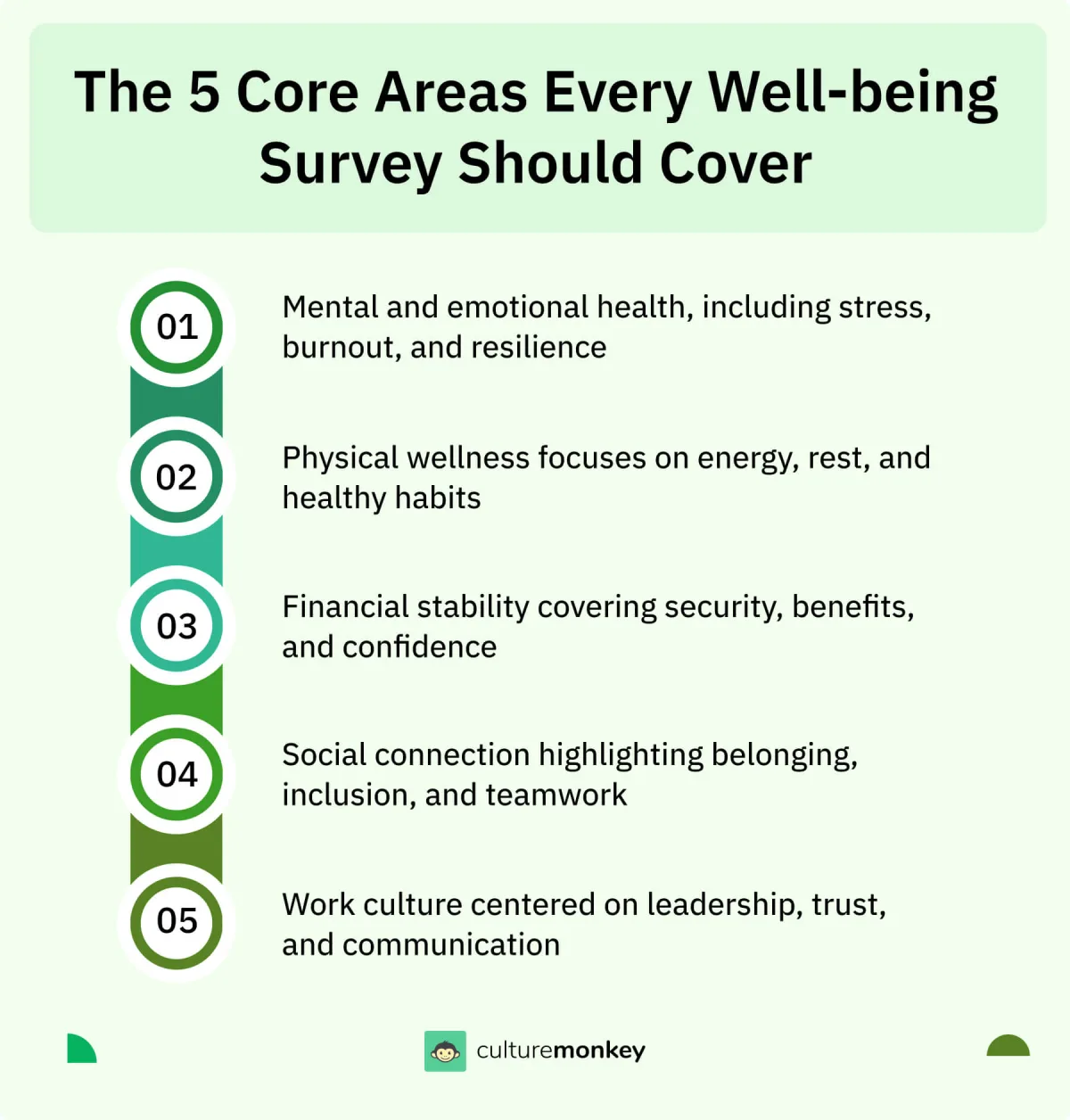
Designing a wellbeing survey is closer to a regular health check on the culture than to an emergency response. The right questions make strain, motivation and support levels visible before anyone has to escalate. These are the areas to cover before you send anything.
- Mental and emotional health
Track stress, mood and coping. Ask how often people feel overwhelmed, supported or anxious, then link the signal to something a leader can change this quarter.
- Physical health and energy
Sleep, energy and movement. These items highlight when the workload or the environment is draining people's bodies, which guides breaks, ergonomics and shift design.
- Work-life balance and workload
Pace, boundaries and downtime. This is where overtime, meeting load and role confusion quietly erode rest, focus and sustainable performance.
- Relationships, inclusion and belonging
Team support, fairness and psychological safety. Whether people feel heard, respected and connected, and where the friction sits.
- Support, benefits and resources
Access to benefits, flexibility and tools. Whether policies and managers make wellbeing easier, or leave people solving it alone after hours.
- Growth, purpose and voice
Learning, recognition and influence. Whether people see a future here, feel proud of the work, and believe leadership listens when they speak.
How to choose the right wellbeing survey question
Choosing questions is like packing a carry-on: the limit forces the decision. Start with what you will do with the answer, then pick the items that fit. Wording is what separates an honest trend line from a set of polite numbers.
- Start with the decision
Pick items that drive a decision, and map each one to an action: scheduling, benefits, manager coaching. If no decision hangs off a question, it is a data-collection habit, not a measure.
- Measure one thing
Target a single dimension per item. Separate mental, emotional and physical wellbeing rather than combining them. Replace vague words with concrete ones: sleep, focus, energy.
- Match the scale to the decision
Use a 5-point frequency scale for behaviour, 0 to 10 for intensity, and yes/no for eligibility. Keep the labels explicit at both ends so nobody has to guess the midpoint.
- Design for action
Pair a rating with an optional comment. The number tells you the size of the problem; the text tells you what it actually is.
- Adapt to context
Adjust wording for remote employees, interns or students. Provide translations. Comparable data depends on everyone reading the same question the same way.
- Pilot, then refine
Test with a small group first. Flag confusing items and low-variance scales. Version the changes so the trend line stays comparable as the questionnaire improves.
The US wellness market alone exceeds $500 billion a year and grows 4 to 5% annually (McKinsey). Wellness is not a passing trend; the question is whether your spend is aimed at anything your data actually showed you.
80 wellbeing survey questions, by dimension

A wellbeing survey is not an engagement survey with softer wording. Engagement measures the relationship with the work; wellbeing measures the person doing it. Engagement surveys run annually and go wide. Wellbeing runs short and often, because the thing it measures changes week to week.
Filter to the dimension you are running, tick the items you want, and copy the set. Each question keeps the scale it was written for.
Nothing selected yet. Tick a question to start building.
Overall wellbeing survey questions for employees
8 questionsThese questions form the foundation of any well-being questionnaire template, helping you assess overall satisfaction, energy, and emotional stability.
Work-life balance and wellness survey questions
8 questionsThese employee wellness survey questions explore how effectively your organization supports personal time and flexibility.
Physical and social wellbeing questions
8 questionsThis section blends health & wellness survey questions with physical, mental, and social wellbeing indicators to give a complete view.
Employee mental health and wellness questionnaire
8 questionsUse these mental wellbeing survey questions to assess emotional resilience, stress levels, and access to mental health support.
Financial wellbeing survey questions
8 questionsThese questions gauge how corporate wellness surveys and financial policies support employee security.
Social connections and inclusion wellbeing questions
8 questionsThese workplace wellbeing questionnaires (WWQ) prompts assessment of belonging, teamwork, and psychological safety.
Work culture and engagement survey questions
8 questionsThese employee engagement survey questions explore leadership trust, recognition, and purpose alignment.
Employee benefits and wellbeing program survey questions
8 questionsThese health and wellness survey questions for employees explore satisfaction with benefits and support programs.
Workplace climate and safety wellbeing survey questions
8 questionsThese staff wellness survey items evaluate safety, fairness, and transparency.
Remote or hybrid employee wellbeing survey questions
8 questionsThese sample wellbeing survey questions for remote or hybrid employees focus on connection, access, and balance.
Building the survey strategy around the questions
A question bank is not a strategy. What turns a set of items into something people answer honestly is structure: a clear objective, a defensible length, a cadence that fits the thing being measured, and a stated purpose.
- Start with clear objectives
Decide upfront what you want to learn: stress levels, engagement, psychological safety. Clear goals frame better questions and prevent a survey that measures everything and decides nothing.
- Keep it short and relevant
A survey that drags produces drop-offs, and drop-offs bias the sample toward the people with time. Every item should trace back to a goal.
- Use a mix of question types
Combine rating scales, multiple choice and open-ended prompts. Structured results give you the trend; personal experience gives you the reason.
- Make timing part of the strategy
Do not wait for the annual review cycle. A quarterly pulse tracks the trend and catches issues before they compound.
- Incorporate follow-up surveys
Use follow-ups to measure whether a wellness initiative did anything. Without a before and an after, a programme cannot be evaluated, only defended.
- Communicate the purpose transparently
People engage when they understand how results get used. Say which policies, benefits and decisions the answers feed into.
Getting honest answers to sensitive questions

Getting people to open up about mental health, stress or money is not easy. If a survey feels risky or vague, the answers stay polite and stay useless. These five moves are what change the tone of the responses.
- Reassure anonymity
State plainly that responses cannot be traced back. Pair the statement with third-party handling, because a promise from the employer is weaker than a mechanism outside it.
- Use empathetic wording
Avoid clinical or judgement-heavy phrasing. Human wording gets human answers; a question that sounds like a diagnosis gets a defensive one.
- Keep it short and focused
Long surveys cause fatigue and rushed answers. Ask only what you will act on.
- Share past actions taken
People are more candid when they have seen feedback lead to change. Reference what the last cycle actually shifted, by name.
- Offer multiple response formats
Include open text alongside the scales. Nuance that does not fit a score is often the most useful thing in the dataset.
How HR teams turn wellbeing data into policy
Wellbeing data is the difference between a hunch and a dashboard before you change lanes. A survey turns scattered feeling into a signal you can act on, so policy improves faster and with fewer unintended consequences.
- Set clear outcomes
Map each question to an action before you send it. Define targets, then commit to changing processes rather than adding perks when a score slips across consecutive pulses.
- Segment for fairness
Break results by role, tenure, shift and location. Fix the conditions first, then coach managers. Treat variance as a system problem, not an individual weakness.
- Triangulate signals
Pair survey comments with behavioural data and exit themes. When the patterns agree, you have found a policy lever worth testing: meeting load, scheduling or tooling.
- Prioritise a roadmap
Translate insight into a quarterly plan. Tackle the highest-friction issue first and publish the owner, the timeline and the expected gain for each change.
- Pilot and iterate
Run controlled trials. Compare pre and post scores plus retention for the pilot group. Keep what moves the needle and retire what does not.
- Close the loop
Share findings in plain language and say what will change next. Transparency is what buys you participation and data quality in the following pulse.
- Equip managers
Provide one-on-one toolkits with check-in questions, escalation paths and boundaries. Consistent check-ins convert insight into habits between survey cycles.
- Set cadence and governance
Quarterly pulses plus an annual deep survey. Establish data owners, revalidation windows and a sunset policy for stale metrics.
Using AI and sentiment analysis on the responses
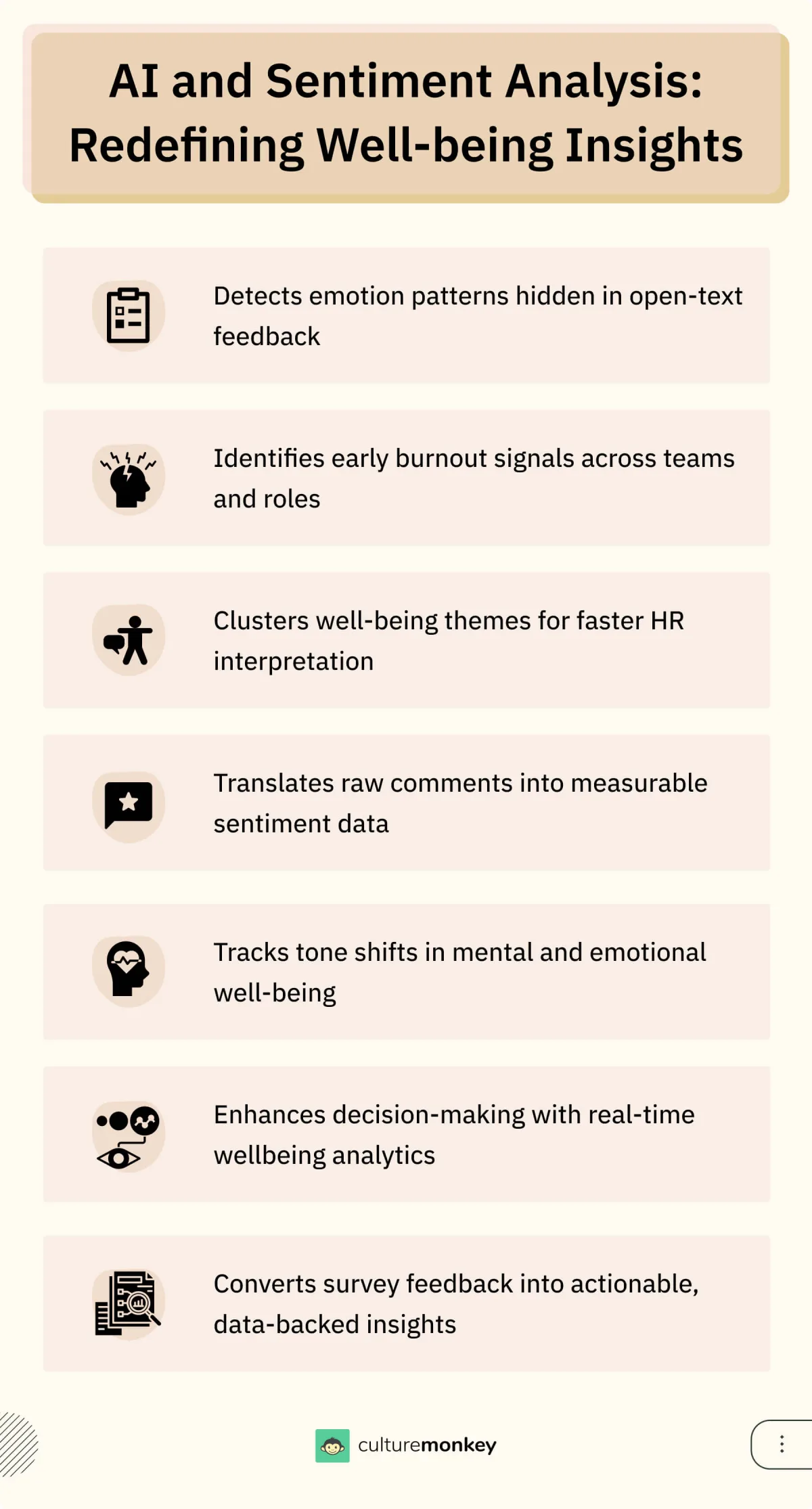
Running sentiment analysis on wellbeing feedback is like switching on subtitles in a noisy meeting: the quiet parts become clear. Tone gets read across open text, and scattered comments turn into patterns you can act on.
- Find signals early
Cluster open text from check-in questions and track an early burnout indicator over time. Spikes by team and shifts in language trigger faster check-ins and workload resets.
- Read emotion, not guesses
Models score positivity, negativity and uncertainty across responses. Pairing theme with frequency lets leaders prioritise the fixes with lift rather than the ones with advocates.
- Personalise by context
Compare sentiment for remote employees and segment by tenure, shift or location, then address tool friction, time zones or onboarding gaps directly.
- Turn patterns into programmes
Map themes to a roadmap: meeting norms, quiet hours, benefits, manager training. Measure before and after so the change is visible and accountable.
- Coach better conversations
Give managers the phrasing, including lighter prompts for tone, so check-ins are consistent and stigma-free rather than improvised.
- Make it repeatable
Standardise the questionnaire across teams, rotate items quarterly, and archive the question bank so learning compounds instead of resetting each year.
Keeping the survey anonymous but still actionable

The biggest barrier to an honest answer is the fear of being identified. Nobody reveals a mental, emotional or financial struggle if they think the response can be traced back. This is why many organisations route wellbeing surveys through third-party survey vendors rather than an internal form.
- Use a trusted external partner
A vendor collecting responses as a neutral party builds confidence in a way an internal form cannot, however good the internal intentions are.
- Set clear anonymity thresholds
Reports should only display aggregated results above a minimum response count. Without a floor, a small team's report identifies people by arithmetic.
- Customise reporting categories
Slice by department, tenure or role without exposing identity. You keep the targeting and lose nothing that matters.
- Communicate the process upfront
Tell people exactly how responses are handled. Transparency about the safeguards is what reduces hesitation on sensitive items.
- Provide action-ready summaries
Translate anonymous data into clear recommendations so leaders know what to improve without needing personal identifiers.
- Regularly audit the system
Check that the process stays secure and compliant. The audit is what keeps the promise credible in the third year, not the first.
Set the anonymity threshold before launch, not after the first awkward report. Below roughly five responses, a departmental breakdown identifies people by arithmetic no matter what the survey promised.
Running wellbeing surveys with CultureMonkey
Running a survey is easy. Running one that produces honesty and then produces action is the part that takes a system. That is the gap CultureMonkey is built for.
Ready-to-use survey templates
Curated health, wellness and psychological safety items, so the first cycle starts from a validated bank rather than a blank document.
Pulse checks made simple
Short pulses track changing mood without overwhelming people, which removes the blind spot between annual surveys.
AI-driven sentiment analysis
Tone and emotion in open-ended feedback are decoded automatically, giving context that scores and charts do not carry.
Actionable reports for leaders
Managers get clear results they can turn into a policy update, not a raw data dump they have to interpret first.
Support for hybrid and global teams
Input is captured across geographies so in-office and remote voices carry equal weight in the result.
End-to-end anonymity
Privacy is guaranteed by the mechanism, which is what makes people willing to answer the most sensitive items honestly.
Frequently asked questions
How do you create a survey for mental health at work?
Design surveys that explore emotional wellbeing, mental health, and overall wellness. Include questions on stress, lifestyle habits, and physical activity over the past week. Add prompts about company support and use varied formats to encourage candid responses. This approach uncovers deeper insights into workplace culture, empowering leaders to build a healthier, more supportive environment.
Should well-being surveys be anonymous?
Yes. Keeping surveys anonymous helps people share honest answers without fear. When employees know their identity is protected, they are more likely to talk about stress, burnout, or support needs. Anonymous surveys reveal deeper insights into wellbeing and job satisfaction, helping you create a safer, more open, and more supportive workplace culture over time.
How often should we run wellbeing checks?
Running surveys monthly or every quarter helps you track how employees feel without overwhelming them. Ask short questions about their stress, health, and support from the past week. Frequent feedback helps you spot problems early, build trust, and create a workplace where people feel heard, valued, and supported before small issues grow bigger.
Can I ask about stress and burnout in a workplace survey?
Yes. Asking about stress, workload, and signs of burnout helps you understand how employees are coping. Questions about sleep, focus, and energy can reveal early warning signs. Addressing these issues quickly with the right support prevents bigger problems, builds trust, and creates a healthier workplace where employees feel balanced and able to perform.
What tools can I use to send and analyze well-being surveys?
Use employee wellness platforms that collect feedback easily and show results clearly. The best tools visualize patterns in stress, physical activity, and support levels. Dashboards help you understand trends and take action. With these insights, HR can improve policies, design better programs, and create a workplace where employees feel healthy, valued, and supported.
What’s the best time to send a wellbeing pulse check?
Send surveys in the middle of the week, ideally Tuesday to Thursday. People reflect more clearly on how they feel during this time. Midweek surveys give more balanced and honest answers about stress, energy, and wellbeing. This small change improves feedback quality and helps you make better decisions about workplace health and support.
How to know if your employees are quietly struggling?
Look for subtle changes like low energy, less participation, or withdrawal from conversations. Combine surveys with regular check-ins to understand how people feel. Honest feedback can reveal early signs of burnout or disengagement. Acting quickly builds trust, offers needed support, and creates a workplace where employees feel cared for and connected.
How do you have a wellbeing conversation at work?
Start with casual, open questions about sleep, habits, stress, and motivation from the past week. Listen carefully and avoid judgment. Building trust helps people share honestly. Talking openly about wellbeing shows you care and strengthens relationships. It also helps you find solutions together, improving health, satisfaction, and workplace culture for the long term.
How to ask wellbeing questions?
Keep questions simple and natural. Ask about sleep, motivation, and energy over the past week. Use a mix of rating scales and open-ended questions to get honest answers. Cover emotional, physical, and social wellbeing for a complete picture. Clear, relatable questions help you understand what employees need and guide meaningful workplace improvements.
What questions should I ask in a wellbeing survey?
Ask about stress levels, daily habits, emotional wellbeing, and how supported people feel. Include questions about work-life balance, motivation, and relationships. Cover different aspects of wellbeing to get a full picture of employee experience. These questions reveal patterns, improve engagement, and guide better decisions to support health and happiness at work.
What are the 5 basic questions for surveys?
These questions build a simple but powerful snapshot of overall employee wellbeing and workplace culture. 1. How did you feel this week? 2. Do you often feel tired or struggle to sleep? 3. Does your company support your health? 4. How are your relationships with coworkers? 5. Do you have a close friend at work?
What’s the best survey solution to measure and improve employee well-being at work?
The best solution combines emotional, mental, and physical health insights in one place. It should collect feedback easily, analyze data quickly, and show clear results. A good tool helps you track trends, spot problems early, and design better support programs. This creates a stronger workplace where employees feel healthy, valued, and engaged.
How often should you run employee wellbeing surveys?
You should monitor wellbeing every quarter to catch changes early across mental wellness, physical wellness, work hours, and stress levels. Frequent surveys help track physical health, healthy work life balance, and the impact of wellness programs. This rhythm strengthens company culture and creates a more positive workplace where employees feel supported consistently throughout the year.
What’s the difference between wellness and wellbeing in surveys?
Wellbeing refers to someone’s overall emotional, mental wellness, physical health, and daily experience at work. Wellness focuses more on lifestyle habits and wellness programs that support physical wellness. In surveys, wellbeing includes connection, purpose, and company culture, while wellness tracks habits that create a positive workplace and help maintain a healthy work life balance.
How can we improve response rates to wellbeing surveys?
Improve response rates by keeping surveys short, sharing why they matter, and showing employees how much importance you place on mental wellness and physical wellness. Offer flexible work hours for completion, highlight how results shape wellness programs, and ensure anonymity. When employees see surveys create a more positive workplace, they respond honestly and more consistently. ---