
CultureMonkey ResearchEmployee EngagementBuyer's Guide

Third-party survey companies:
what they do, and the 7
worth shortlisting.

Short answer

Third-party survey companies are independent providers that design, distribute and analyze employee surveys on an organization’s behalf, so responses are collected and anonymized outside its own HR systems. Organizations use one for three reasons: neutrality, because the provider has no stake in how results read; anonymity employees trust, because the people who manage them never hold the raw answers; and external benchmarking, which no single employer can build alone. The 7 providers below are compared on those terms.

Skip to the 7 companies
How the order was decided

Every provider had to clear a public G2 rating of 4.3 or higher. The 7 that cleared it are ordered by breadth of third-party service: independence and anonymity controls, depth of benchmarking data, analytics and action planning, reach for employees without corporate email, and pricing transparency. G2 is reported for every entry and is not the ordering key. CultureMonkey publishes this page, so a publisher rule applies: it is placed third, below the two independent platforms that score highest on service breadth, even though it holds the highest G2 rating shown here at 4.7.

  • Why G2 is not the ordering key: a 4.7 from small-team buyers and a 4.4 from enterprise buyers measure different populations, so the order and the scores do not line up.
  • Evidence used: G2 reviews, provider documentation, and product research by CultureMonkey’s people science team.
  • Independence: no provider paid for placement, and no provider saw its entry before publication.
What we found3 verdicts from evaluating 7 providers
01
Neutrality changes the data
Employees respond more honestly to a third party. The gap between internal and external survey results is not marginal.
02
Benchmarking is the real differentiator
The tools that show how you compare to industry peers are worth more than those that only show your own trend line.
03
Action cadence matters most
The platforms that push managers to act within days of results, not weeks, are the ones that actually move engagement scores.
Written by
Santhosh, Sr. Content Strategist at CultureMonkey
Writes about how companies actually listen to employees: survey design, feedback loops, and where most engagement programs break down with people science research. 250+ articles deep on the topic.
3 years in HR tech
Data verified by
Research team analyzing engagement across 19 industries globally.
~11M responses
22 min read|Updated |Benchmark data: Q3 2026
The case for external

What is a third-party survey company, and why do they exist?

A third-party survey company is an independent provider that designs, distributes, and analyzes surveys for organizations. The work runs on the provider's own platform: employee engagement surveys built from a validated question library, structured survey design, and data collection that sits outside the employer's systems. If you are comparing the software rather than the service, our guide to employee engagement survey tools covers that side.

What the arrangement buys is distance. The provider has no stake in how a result reads, keeps the raw responses out of the employer’s hands, and compares your scores against a benchmark set no single employer could assemble. That is why organizations keep paying for it rather than running surveys in-house with a generic form builder, and why employee feedback gathered this way carries more weight with leadership.

The #1 reason companies switch to external providers

It is trust. Employees hold back when the people reading the answers are the people writing their reviews. A neutral processor removes that calculation, so what reaches leadership is closer to what employees actually think. For large and dispersed workforces this is the whole point of the spend: a culture of openness, and data leaders can act on with some confidence it is real.

Only 20% of employees worldwide are engaged at work, and lost productivity from disengagement now costs the global economy around $10 trillion a year, roughly 9% of global GDP.
Gallup, State of the Global Workplace 2026
Why Third-Party

8 reasons organizations hire a third party for employee feedback

Each of these is something an internal survey run on a generic form builder struggles to deliver.

01
Reporting with no internal stake
The provider has nothing riding on how a result reads, so nothing gets softened on the way to leadership.
02
Anonymity by design
Response thresholds and separated identifiers are built into the platform, not bolted on. Our anonymous feedback tool page covers the mechanics.
03
Stronger participation rates
Employees respond more when they believe the survey is handled independently of their reporting line.
04
Access to benchmarks
Industry comparisons give context to your scores, and show where sector peers are ahead.
05
Advanced analytics
Dashboards turn raw feedback into patterns, trends, and engagement hotspots across teams.
06
Time and resource savings
The provider handles design, distribution, and analysis, which frees HR for the response.
07
Customizable templates
Pre-built, research-backed question sets adapted to your engagement, performance, or culture needs.
08
Scalability for growth
As headcount grows, automated distribution and reporting scale without overwhelming HR.
7 Platforms Reviewed

How these 7 providers were evaluated

Each platform was assessed against the criteria in the method statement at the top of this page. The table reports its G2 rating, survey types, pricing transparency, and the company sizes it serves best.

ToolBest for organizations that needG2 ScoreSurvey typesBest Company SizePricing
Qualtrics XMEnterprise experience management and benchmarking4.4Engagement, pulse, lifecycle, EX research1,000+Contact sales
Workday PeakonContinuous employee listening in Workday ecosystem4.6Engagement, pulse, lifecycle500–5,000Contact sales
CultureMonkeyEnterprise engagement surveys and frontline feedback4.7Engagement, pulse, lifecycle, culture1,000+Contact sales
Officevibe (Workleap)Simple pulse surveys for small teams4.7Pulse, engagement, team feedback50–1,000$5/user/month
15FiveContinuous feedback and manager check-ins4.6Pulse, engagement, check-in50–500$4/user/month
Culture AmpEngagement surveys with long-term trend tracking4.5Engagement, pulse, lifecycle200–2,000Contact sales
Microsoft Viva GlintEnterprise engagement analytics in Microsoft ecosystem4.6Engagement, pulse, lifecycle1,000+Contact sales
Case Study · Aujan Coca-Cola
86.2%
Participation across all regions
41,436
Data points captured in one cycle
8.3
Engagement score baseline

"In just seven days, CultureMonkey designed and launched our survey to 2,000 employees across multiple geographies and in five languages. A feat that would normally take 45 days."

Susan Gardner
Susan Gardner
CHRO · Aujan Coca-Cola
CultureMonkey Research · Q3 2026

Engagement benchmarks: what good looks like

By RegionQ3 2026 · avg score /10
APAC
−0.098.22
Steady
LATAM
+0.198.22
Growth
MEA
−0.128.14
Watch
North America
+0.197.9
Growth
Europe
+0.047.67
Steady
By Company SizeQ3 2026 · avg score /10
Enterprise (2000+)
−0.188.16
Watch
SMB (100–500)
+0.288.09
Growth
Mid-Market (500–2000)
−0.068.07
Steady
Micro (<100)
−0.187.7
Watch
Source: CultureMonkey People Science Team, analysis across ~11M responses, 19 industries globally.
Platform Reviews

Top 7 third-party survey companies for employee feedback

Each entry covers features, G2 score, pricing, who it's best for, and where it falls short. For the full vendor roundup beyond third-party specialists, see our guide to the best employee engagement survey vendors.

Nº 01 / 7

Qualtrics XM

★ 4.4 G2
G2 Rating
4.4 / 5
Pricing
Contact sales
Best For
Enterprise benchmarking
Company Size
1,000+ employees
Qualtrics XM · Interface preview
Qualtrics XM employee survey platform interface

Qualtrics XM is a familiar name in the employee experience space, offering tools that support feedback collection across the entire employee lifecycle. Known for its broad feature set and integrations, the platform helps HR teams design and distribute surveys, track sentiment, and analyze results to inform engagement strategies at scale.

FeatureWhat it gives you
Comprehensive feedback typesPulse, onboarding, exit, lifecycle, and satisfaction surveys covering the full employee journey
Deep question libraryBenchmarkable items and expert-validated content to support rigorous EX design
Real-time listeningFrequent, agile pulse surveys that capture evolving sentiment at scale
AI-powered insightsGenerative and predictive AI to summarize trends and guide follow-up action
Integrated EX platformConnects feedback, analytics, and HR workflow with Experience Management tools
Best for
Large organizations needing deep benchmarking and advanced engagement survey dashboards. Provides enterprise benchmarking and advanced reporting for analyzing results at scale.
Watch out for
  • Platform navigation can feel complex for new users, and implementation typically requires a significant professional services investment via G2
Standout

Cross-industry benchmark database

Qualtrics sits on one of the largest EX benchmark datasets available, which helps enterprises that need to contextualize scores against sector peers.
Nº 02 / 7

Workday Peakon

★ 4.6 G2
G2 Rating
4.6 / 5
Pricing
Contact sales
Best For
Workday ecosystem
Company Size
500–5,000 employees
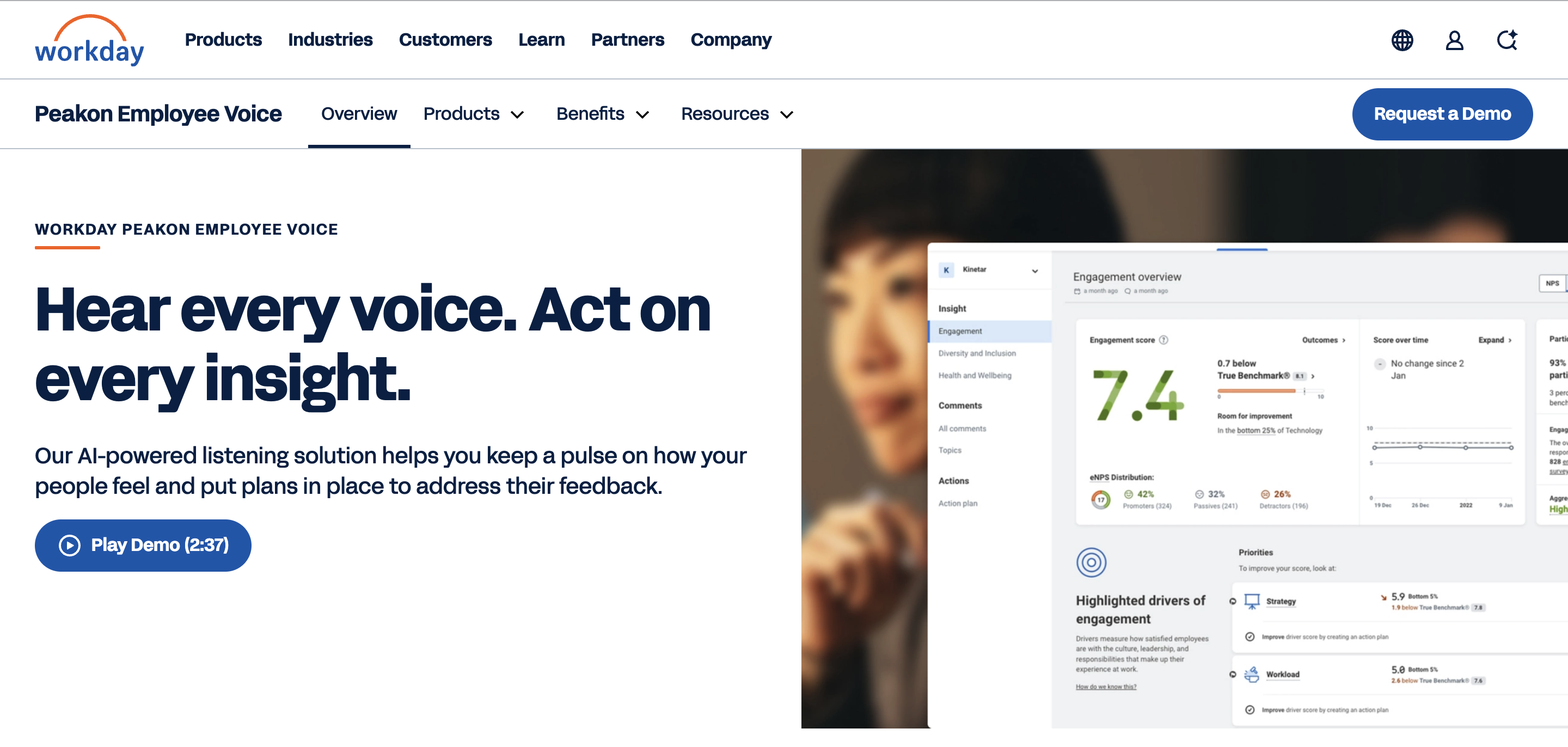
Workday Peakon · Interface preview
Workday Peakon employee listening platform interface

Workday Peakon, now called Workday Employee Voice, is designed to capture continuous feedback across the employee lifecycle. The platform blends AI, benchmarks, and analytics to help leaders understand engagement trends and turn employee sentiment into actionable insights.

FeatureWhat it gives you
Intelligent survey flowsFollow-up questions adapt based on earlier responses, surfacing richer qualitative data
Industry benchmarkingAdjusted comparisons help organizations measure engagement accurately against sector peers
Attrition risk forecastsAI identifies turnover risks early, enabling proactive retention strategies
NLP-powered insightsNatural language processing surfaces trends and sentiment drivers from open text
Science-based question librariesBuilt-in behavioral science ensures question validity across the employee lifecycle
Best for
The natural fit for enterprises already running Workday HCM. Org hierarchy and employee data sync automatically, which removes the manual maintenance every survey cycle.
Watch out for
  • Value diminishes significantly outside the Workday ecosystem, and pricing is high relative to standalone alternatives via G2
Standout

Native Workday HCM integration

No CSV uploads, no manual maintenance. Org hierarchy, manager assignments, and employee data sync automatically, saving HR teams hours every survey cycle.

Nº 03 / 7

CultureMonkey

★ 4.7 G2
G2 Rating
4.7 / 5
Best For
Enterprise engagement surveys + action planning
Company Size
1,000+ employees
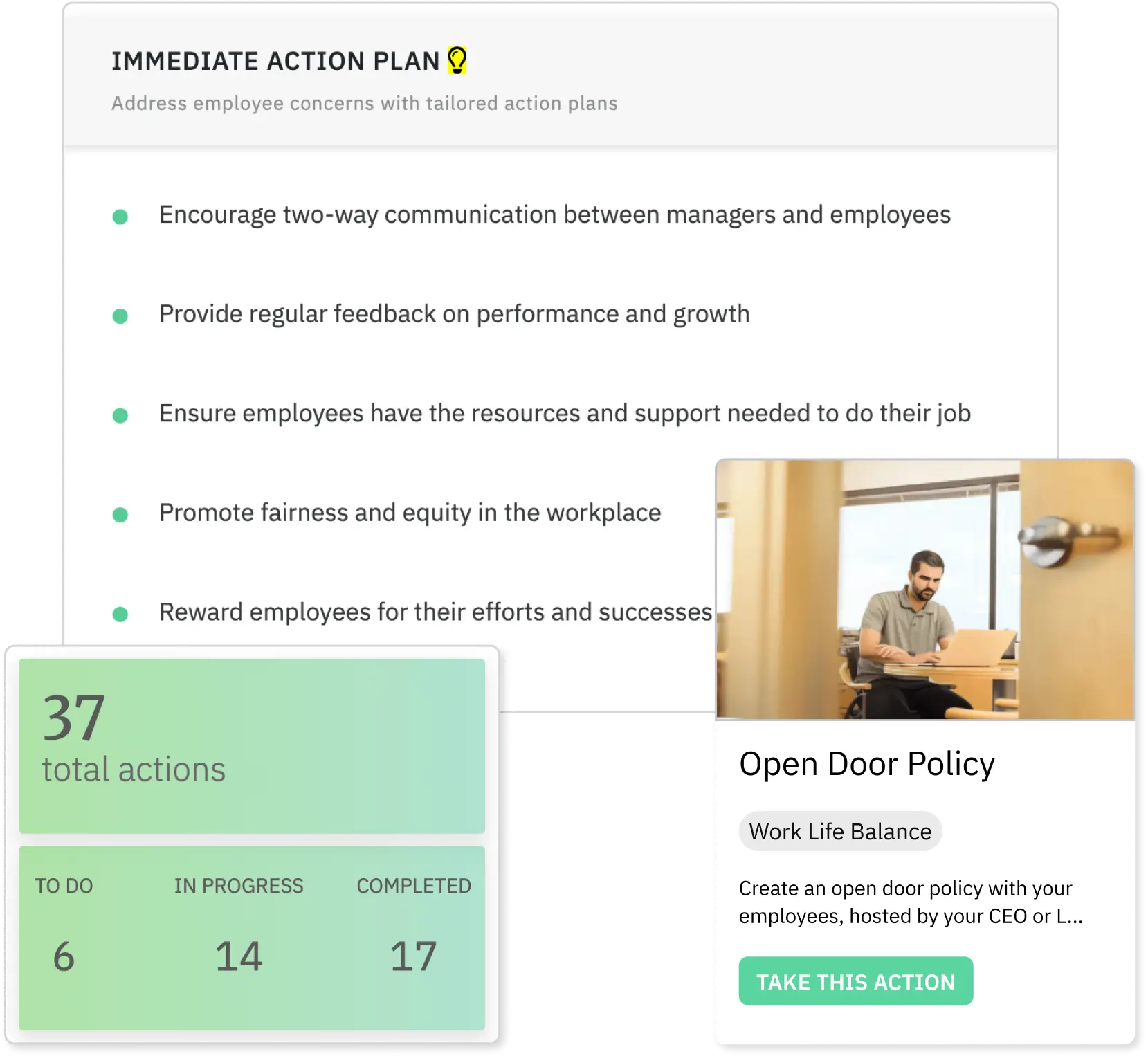
2 screenshots · click to expand
CultureMonkey engagement survey dashboard
Survey analytics · Dashboard
CultureMonkey action planning interface
Action planning · Manager view

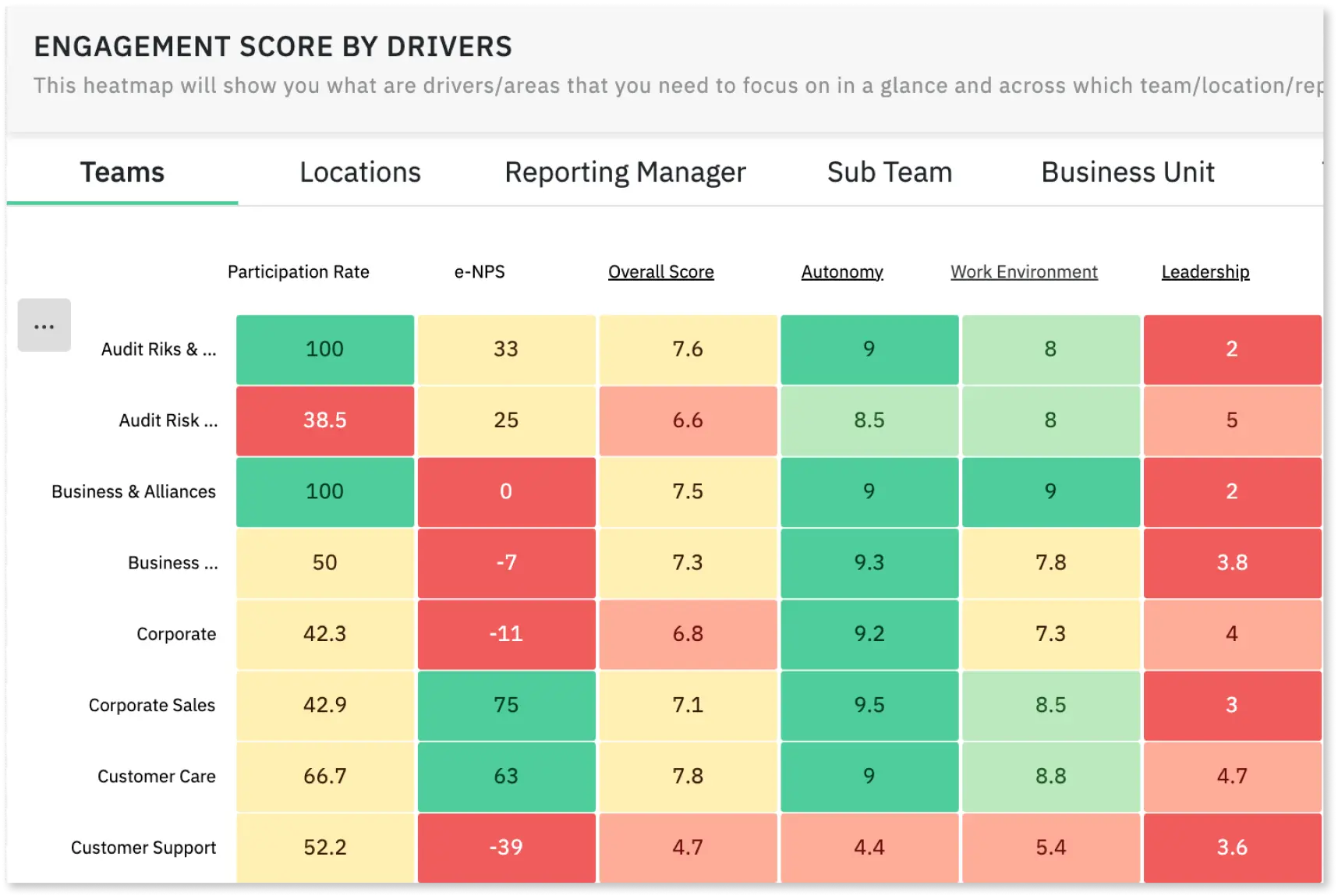
CultureMonkey is an enterprise employee survey platform combining secure anonymous feedback delivery, AI-powered text analytics, heatmap reporting, benchmarking, and structured action planning. Supports role-based access controls, configurable anonymity thresholds, and 17+ HRIS integrations for enterprise engagement programs.

FeatureWhat it gives you
Enterprise-grade anonymitySOC 2 compliance, GDPR-aligned data controls, and encrypted storage keep employee data secure
Benchmarking engineIndustry benchmark datasets and historical comparison models evaluate engagement scores over time
AI sentiment analysisNLP models classify open-text feedback into themes and sentiment trends automatically
Heatmap analyticsTeam-level dashboards and visual heatmaps reveal engagement patterns across departments and managers
Action planning systemWorkflow tools assign owners, track initiatives, and monitor improvements after each survey cycle
Best for
Enterprise organizations that need anonymous third-party employee surveys with strong confidentiality controls, AI analytics, benchmarking, and structured action planning. Multi-channel delivery extends reach to frontline employees as one additional use case.
Watch out for
  • Some users report wanting deeper self-serve analytics customization for niche reporting needs via G2
Standout

Delivery that does not need a corporate inbox

Most platforms on this page assume every employee has company email. Multi-channel delivery over WhatsApp, QR codes and kiosk mode is what changes the reachable population.

"
CultureMonkey's platform gave us a venue to do that, as well as for utilizing some AI knowledge within the platform to suggest some action plans that may work for them. And that was very helpful so that we were not trying to reinvent the wheel for our managers.
Elizabeth Egan
Elizabeth Egan
Director of Talent Management & OD · Cerence AI
Read case study →
Nº 04 / 7

Officevibe (Workleap)

★ 4.7 G2
G2 Rating
4.7 / 5
Pricing
$5/user/month
Best For
Simple pulse surveys
Company Size
50–1,000 employees
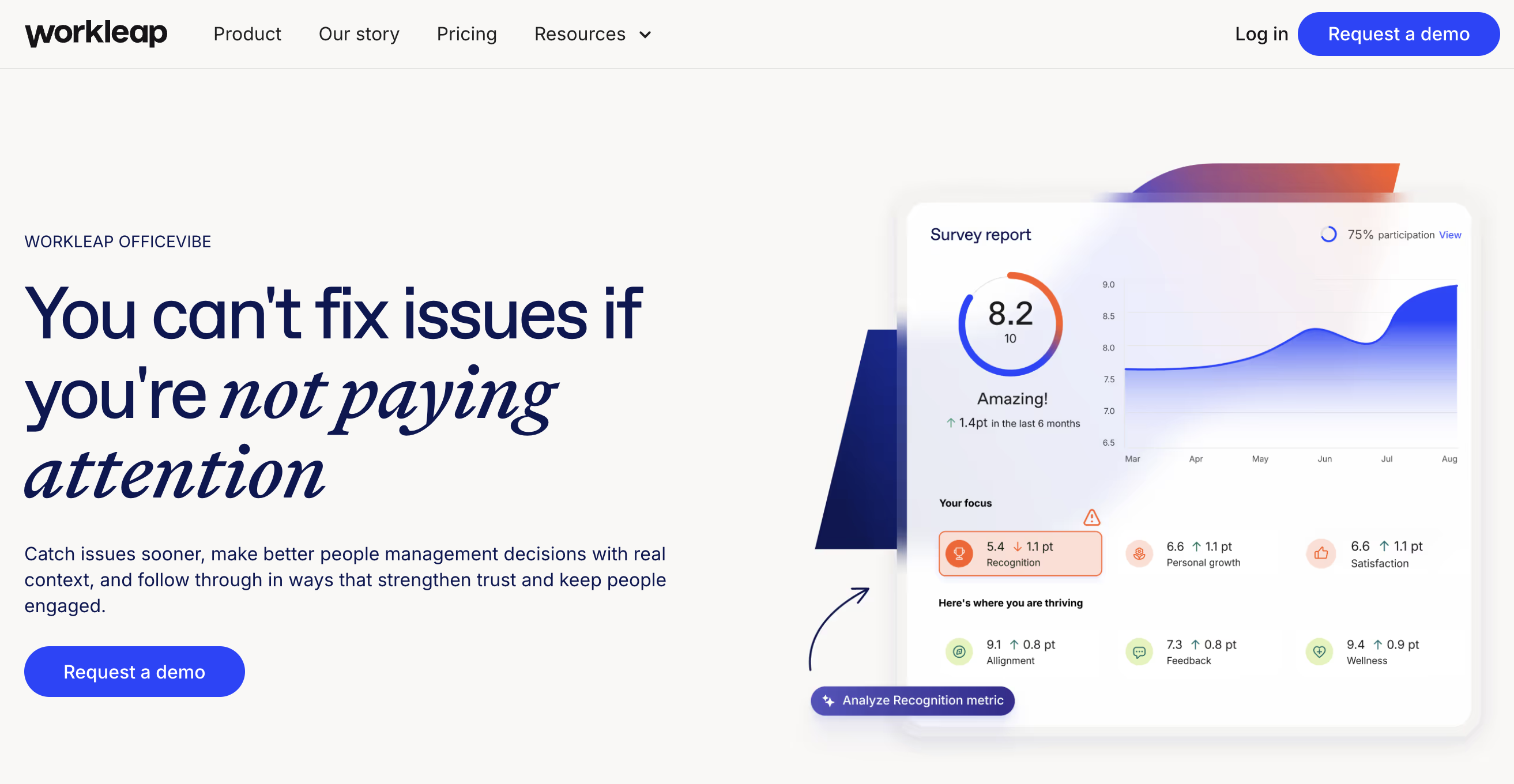
Workleap Officevibe · Interface preview
Workleap Officevibe pulse survey platform interface

Workleap (formerly Officevibe) delivers an engaging, modular survey and feedback platform built on simplicity and AI-led insights. Designed to create ongoing dialogue, it helps HR and people teams measure morale, pulse key engagement metrics, and encourage meaningful interactions across teams.

FeatureWhat it gives you
Automated pulse surveysFrequent, compact check-ins using sliders, ratings, and multiple choice for quick team insights
Anonymous messaging follow-upContinued anonymous conversation after initial feedback, deepening qualitative data
AI-summarized insightsHighlights trends and themes in real time, making ongoing improvement workflows effortless
Feedback reporting dashboardTrends and usage metrics in one place so managers can track engagement activity easily
Peer recognition tools'Good Vibes' cards and prompts that reinforce positive behaviors within teams
Best for
Teams that want simple pulse surveys and real-time engagement reporting at the most accessible price point on this list.
Watch out for
  • Survey customization and analytics depth feel limited compared to enterprise-tier platforms via G2
Standout

Live without a procurement cycle

Purpose-built for team leads and SME HR teams that need structured feedback this quarter rather than next year. Billing is annual with a 10-user minimum, so plan for at least 10 seats.

Nº 05 / 7

15Five

★ 4.6 G2
G2 Rating
4.6 / 5
Pricing
$4/user/month
Best For
Continuous feedback + check-ins
Company Size
50–500 employees
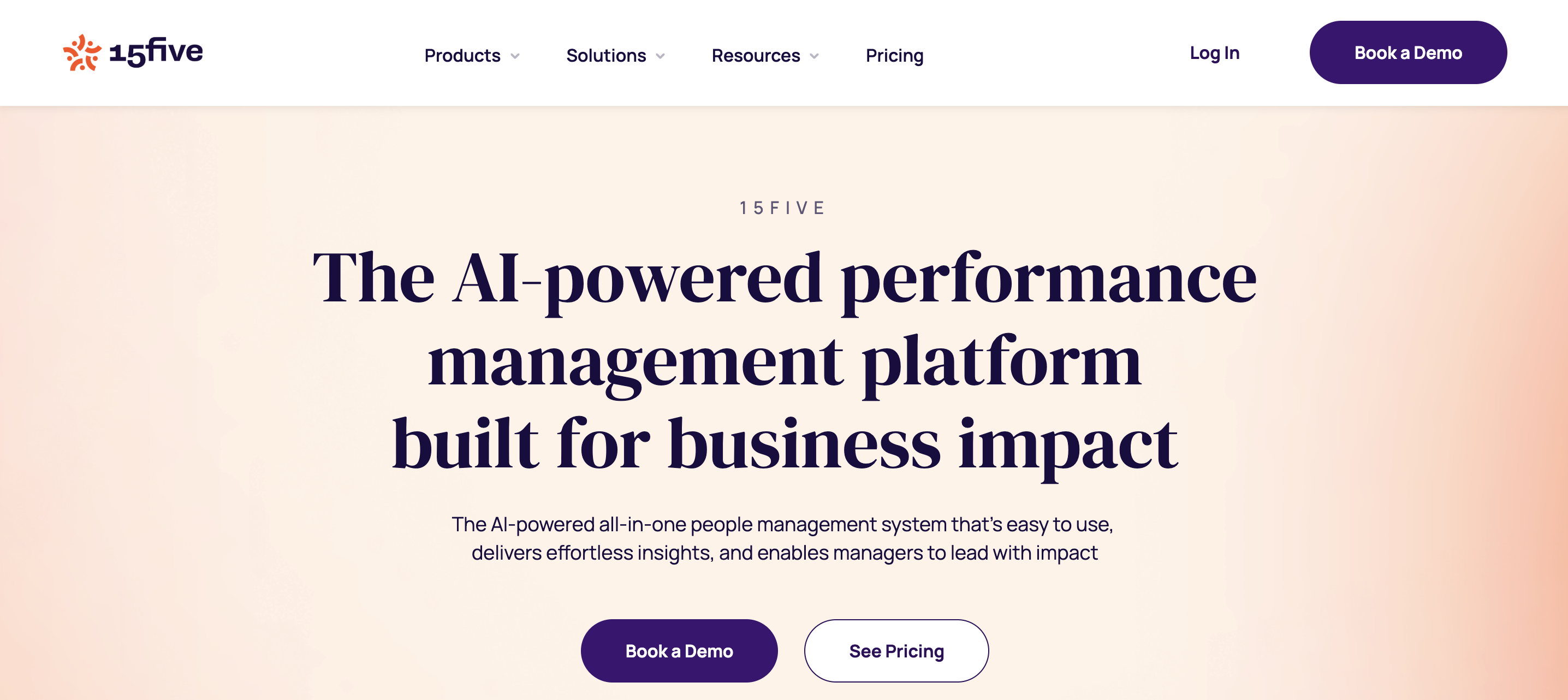
15Five · Interface preview
15Five continuous feedback and engagement platform interface

15Five centers around continuous feedback and engagement, combining pulse surveys with lifecycle tracking and check-ins. Built to guide HR and people teams, it helps surface sentiment, identify trends, and support ongoing culture development, without overwhelming managers or teams.

FeatureWhat it gives you
Pulse in check-insQuick sentiment check-ins integrated into regular workflows to capture real-time employee mood
Automated lifecycle surveysFeedback surveys at key career stages (onboarding, milestones, exit) with minimal admin
Adaptive engagement campaignsPrebuilt, research-backed engagement surveys and custom topic-based assessments
Pulse dashboard analyticsTeam sentiment trends in real time with average scores and group visibility filters
AI-powered action planningPredictive analytics and action plan tools to help HR close the feedback loop
Best for
Organizations wanting simple feedback tools and guided manager check-ins at the lowest per-user cost of any platform on this list.
Watch out for
  • Survey data can feel less granular for complex orgs, and HRIS integration depth is limited vs. enterprise platforms via G2
Standout

Check-ins and surveys in one loop

Weekly manager check-ins sit alongside structured pulse surveys, which suits people teams that want continuous listening without a dedicated engagement platform budget.

Case Study · Robertshaw
4×
eNPS growth (9.21 → 38.11)
71%
Reduction in actively disengaged
8.7
Engagement score
Year 1→2
Measurable YoY improvement
Heather Kane
Heather Kane
Change Management & Employee Engagement Lead · Robertshaw
"

The problem CultureMonkey solves is getting to a mostly frontline workforce in nine different languages, half a dozen of which aren't common. It makes it really easy, so we can spend more of our time on the output that actually matters.

Nº 06 / 7

Culture Amp

★ 4.5 G2
G2 Rating
4.5 / 5
Pricing
Contact sales
Best For
Engagement with trend tracking
Company Size
200–2,000 employees
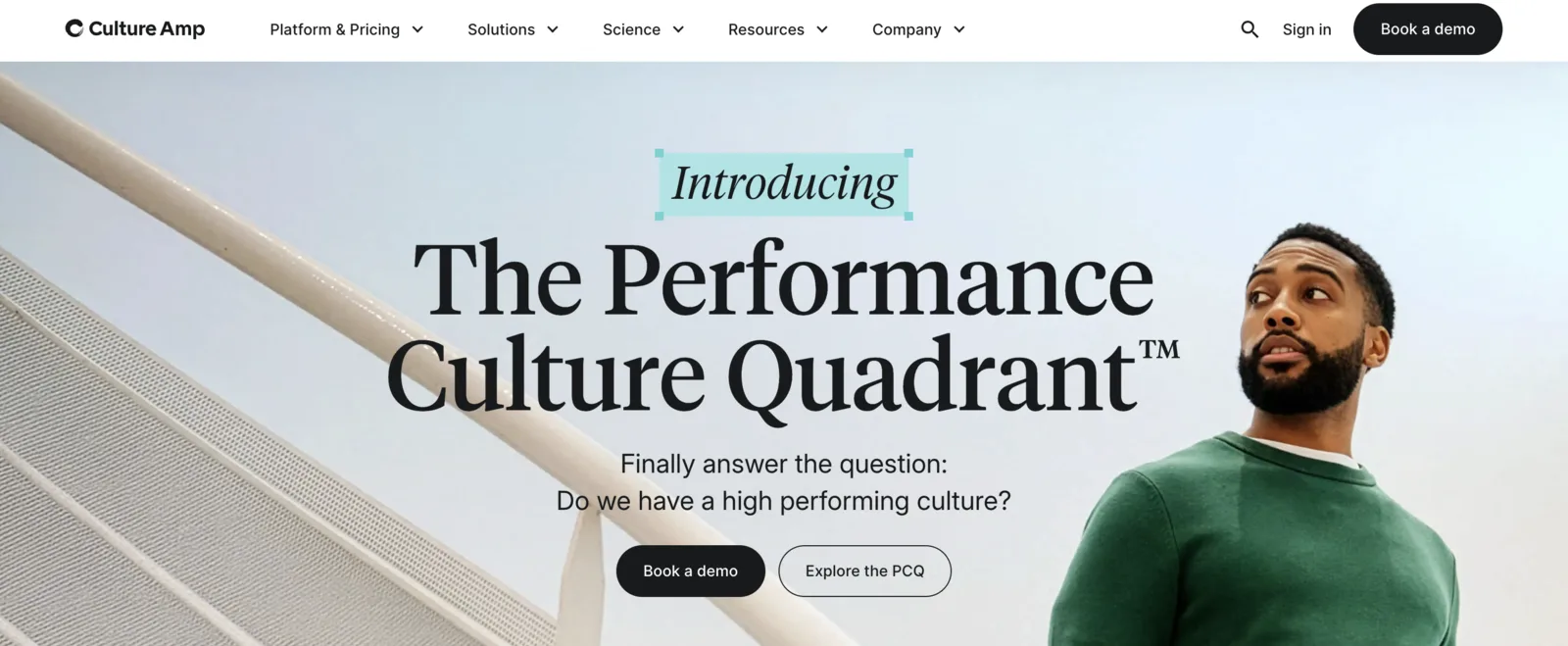
Culture Amp · Interface preview
Culture Amp employee engagement and performance platform interface

Culture Amp is an all-in-one platform offering tools to measure and improve employee experience across engagement, performance, and development. Known for its behavioral science foundation and breadth of survey formats, the platform empowers HR teams to gather insights and turn them into measurable action.

FeatureWhat it gives you
Science-backed templates40+ research-backed survey templates that ensure credibility and reduce guesswork
AI comment analysisSummarizes open-text feedback using AI, making large-scale qualitative data digestible
Industry benchmarkingCompare results with thousands of organizations using collective data insights
Holistic performance feedbackIntegrates 360-degree reviews, goals, and well-being into an engagement-first feedback system
Survey summary transparencyShare high-level results securely across teams including favorability and demographic breakdowns
Best for
Organizations wanting easy engagement surveys and long-term score tracking. Practical tools with clear tracking over time, strongest for mid-market desk-based workforces.
Watch out for
  • Support response times can feel slow during urgent situations, and frontline/deskless employee support is limited via G2
Standout

40+ behavioral-science survey templates

Built by I/O psychologists, Culture Amp's template library is among the most research-validated on the market, reducing the design burden for first-time formal engagement programs.

"
Switching to CultureMonkey and connecting to our real HR data has just been a game changer for us. Now I can see engagement information down to the manager level, which is just a completely different world.
Lisa Watts
Lisa Watts
Chief People Officer · Astra Service Partners
Read case study →
Nº 07 / 7

Microsoft Viva Glint

★ 4.6 G2
G2 Rating
4.6 / 5
Pricing
Contact sales
Best For
Microsoft 365 organizations
Company Size
1,000+ employees
Microsoft Viva Glint · Interface preview
Microsoft Viva Glint employee engagement analytics interface

Microsoft Viva Glint is part of the Microsoft Viva suite and focuses on collecting employee feedback through surveys. It provides different survey formats, from quick pulse checks to lifecycle surveys, to help organizations understand employee sentiment and identify areas for improvement. One buyer note: Microsoft has been trimming the Viva suite, retiring Viva Goals on December 31, 2025 and winding down Viva Topics, but Viva Glint itself remains active and continues to ship feature updates in 2026.

FeatureWhat it gives you
People science-based templatesResearch-backed templates covering engagement, lifecycle, and special topics for reliable data
Always-On feedbackContinuous access to feedback through surveys that employees can submit at any time
Copilot-powered insightsAI (Copilot) summarizes comments and highlights trends quickly across large datasets
Flexible benchmarkingInternal, external, and trend-based comparisons for robust contextual analysis
Configurable privacy thresholdsSets response thresholds to protect anonymity in insights and manager-level reporting
Best for
The natural fit for organizations already invested in Teams, SharePoint, and Microsoft 365. Glint surfaces engagement data natively within the productivity tools employees already use daily.
Watch out for
  • Heavily dependent on the Microsoft ecosystem, with limited value outside it, and navigation can feel complex without deeper platform familiarity via G2
Standout

Microsoft 365 + Teams native integration

Survey nudges, results, and action plans surface directly inside Teams, removing the context switch that typically kills manager adoption of standalone engagement platforms.

Case Study · United Bank

"CultureMonkey made it easy to automate our employee engagement surveys while still giving us the flexibility to customize them. Their real-time data analysis helped us uncover key focus areas and align our strategy with industry benchmarks."

Mollie Mock Kaufman
Mollie Mock Kaufman
Director of Talent Development · United Bank
80%+
Participation across 2,000+ employees
+10%
Above financial industry benchmark
+13%
Growth & development vs. industry avg

Which third-party survey platform is right for you?

Answer five questions and get a personalized recommendation based on your organization size, priorities, and tech stack.

How large is your organization?
What's your top priority from a survey platform?
Which HR system are you running?
What's your budget?
Do you have frontline or non-desk workers who need to be surveyed?
Based on your answers, we recommend:
    Step 1 of 5
    Pitfalls

    Common mistakes companies make when running internal surveys

    Without the right structure and neutrality, feedback can easily lose its value. Here are the most common traps:

    • Lack of anonymity: Employees hesitate to share honest feedback if they believe their identity can be traced.
    • Unclear objectives: Surveys launched without clear goals collect data but fail to provide actionable insights.
    • Overly long surveys: Lengthy forms discourage participation and reduce overall response quality.
    • Poor question design: Ambiguous or leading questions skew results and make data difficult to interpret.
    • Inconsistent follow-up: Not acting on survey results damages credibility and reduces trust in future feedback.
    • Limited analytics: Internal surveys often lack the depth that employee feedback vendors provide.
    • Scalability issues: As organizations grow, managing in-house surveys becomes inefficient compared to a third-party partner.
    Context

    Internal vs. external surveys: What's the actual difference?

    AttributeInternal SurveysExternal Surveys
    Trust & anonymityEmployees may hold back due to lack of anonymity.Third-party companies ensure anonymity, encouraging honest responses.
    Survey designBuilt manually with limited expertise and generic tools.Research-backed templates and proven frameworks by design.
    Analytics & insightsReporting is basic, often limited to raw data or charts.Advanced analytics deliver benchmarks, trends, and actionable insights.
    ScalabilityBecomes harder to manage as the workforce grows.Scales seamlessly with automated distribution and reporting.
    Resource demandHR teams spend significant time on setup and analysis.External partners streamline survey creation and feedback analysis.
    Exceptions

    When NOT to hire a third party survey company

    External providers aren't always the right choice. Consider these scenarios before committing to a vendor.

    01

    Very small teams

    Direct conversations may be more effective than formal surveys. The overhead of a third-party platform may not be justified.

    02

    Limited budgets

    If resources are tight, free tools like Google Forms may be sufficient for basic feedback needs.

    03

    Simple feedback needs

    When gathering quick input on a single topic, a basic internal tool is often enough.

    04

    Lack of leadership readiness

    If leadership isn't committed to acting on feedback, a vendor won't create impact. The platform is only as valuable as the organization's willingness to respond.

    05

    Short-term projects

    For temporary initiatives, building a long-term vendor relationship may not add value.

    Evaluation Framework

    HR checklist: how to evaluate a third-party survey provider

    Run every shortlisted provider through the same ten checks below. Most 3rd party survey providers will clear the first five on a sales call; the last five are where they separate, and where a weak fit shows up six months after signing. Security and compliance deserve their own pass, which our employee survey vendor security checklist sets out question by question.

    01

    Proven expertise

    Deep experience in employee engagement and survey design, with frameworks that are tried, tested, and effective.

    02

    Anonymity and trust

    The platform must prioritize anonymity. Employee confidence directly impacts survey accuracy.

    03

    Customization options

    Surveys tailored to your organization's culture and goals, and flexible as priorities evolve.

    04

    Multilingual support

    Language inclusivity brings in feedback from every corner of the workforce, including the sites HQ rarely hears from.

    05

    Integrations

    Works with your HRMS, communication tools, and existing workflows without friction.

    06

    Analytics depth

    Heatmaps, sentiment analysis, and benchmarks built so leadership can act on the data, with the owner and the next step already clear.

    07

    Ease of use

    Intuitive for both HR teams and employees, because a clear design lifts adoption and participation.

    08

    Scalability

    Grows with your organization's size and complexity, with no vendor switch as headcount increases.

    09

    Action planning tools

    Features that help managers translate survey insights into concrete next steps and accountability.

    10

    Support and onboarding

    Strong customer success and onboarding resources to maximize value from day one.

    After the Survey

    How to interpret and act on results from third-party surveys

    Gallup finds that managers account for 70% of the variance in team engagement, which means the value of any survey lives or dies in how manager-level engagement data gets interpreted and acted on. Here's how to get full value from your survey investment.

    01

    Segment the data

    Break down results by department, role, or location to identify patterns. Address problems at the level where they sit, not only organization-wide.

    02

    Spot recurring themes

    Consistent feedback trends, positive or negative, often point to systemic gaps that one-off interventions will not fix.

    03

    Prioritize critical issues

    Focus first on areas that directly impact engagement, retention, and well-being. Quick wins build momentum for the broader program.

    04

    Benchmark against industry

    External comparisons reveal whether a challenge is internal or market-wide, which changes the intervention entirely.

    05

    Share results transparently

    Transparency shows employees their answers mattered, and it decides whether the next survey gets higher participation.

    06

    Link insights to action

    Turn survey outcomes into concrete plans with assigned responsibility. Feedback only creates value when someone is accountable for acting on it.

    07

    Track progress over time

    A follow-up cadence turns feedback into a cycle instead of a one-off event that fades from the calendar. Shorter check-ins between annual surveys are what pulse survey tools are built for.

    Global Readiness

    Can a third-party survey provider help with global teams and multilingual surveys?

    For multinational organizations, running surveys that resonate across diverse cultures and languages is one of the hardest challenges. Internal tools often struggle with inclusivity. Here's where third-party providers deliver:

    • 100+ language delivery: employees respond in the language they're most comfortable with.
    • Cultural sensitivity: questions are adapted so feedback is accurate and respectful across geographies.
    • Centralized reporting: one dashboard for global comparison, with regional breakdowns preserved.
    • Global benchmarks: comparative data across industries and regions gives leaders genuine context.
    • Enterprise scalability: automated distribution for thousands of employees, with no HR overhead as headcount grows.
    Spotlight

    The role of CultureMonkey as a hybrid feedback platform + strategic survey partner

    CultureMonkey is the third provider on this page, and this is what it does differently: it pairs the neutrality any external processor gives you with the reporting depth of an enterprise engagement platform, rather than stopping at survey delivery.

    01

    Templates you can take apart

    Start from a prebuilt set or rebuild it. Every question, scale and section is editable, so the survey reads in the organization's own language.

    02

    Translation handled for the team

    HR uploads one survey and the provider delivers it in each employee's own language, with the translation workflow sitting on the provider's side rather than with the HR team.

    03

    Reporting grounded in people science

    Question sets and scales are validated by the people science team before they ship, so a score means the same thing from one cycle to the next.

    04

    Integrations that survive a reorg

    HRIS sync keeps hierarchy and manager assignments current, so a restructure does not quietly break the next survey's reporting lines.

    05

    Thresholds you set yourself

    The minimum number of responses needed before a cut becomes visible is a setting, not a fixed rule, so it can be raised for small or sensitive teams.

    06

    People, not only a login

    HR and behavioral science specialists sit on survey design, cadence and the action review with managers, which a self-serve tool does not provide.

    FAQ

    Frequently asked questions

    Can third-party vendors run anonymous employee surveys?
    Yes, and that is the most common reason to bring one in. When third party vendors run anonymous employee surveys, responses land in the provider's platform instead of an internal HR system, and identifying fields are separated from the answers before any result reaches a manager. Providers also apply a minimum response threshold, so a team's result stays hidden until enough people in that team have replied, which is what prevents small groups from being identified by elimination. Employees tend to answer more openly under that arrangement, because the people who manage them never hold the raw responses.
    How do third-party survey companies ensure data security and compliance?
    Third party survey companies protect responses with encrypted storage, role-based access controls, and defined data residency. Established providers commonly hold ISO 27001 or SOC 2 attestations and operate under GDPR, and most publish the scope of each one so buyers can check what is actually covered. Ask for current certificates, the data processing agreement, and the anonymity threshold settings in writing before signing, because the scope of an attestation matters more than the badge.
    How much do third-party employee survey companies cost?
    Pricing splits into two models. Per-seat platforms publish a rate: 15Five starts at $4/user/month billed annually, and Workleap Officevibe at $5/user/month billed annually with a 10-user minimum. Enterprise platforms including CultureMonkey, Qualtrics XM, and Microsoft Viva Glint quote on request, with the number driven by headcount, the survey types in scope, and HRIS integration work.
    What HRIS systems do third-party survey platforms integrate with?
    Most connect to the major HRIS systems, though the depth varies. CultureMonkey connects to Workday, SAP SuccessFactors, Darwinbox, and BambooHR among others. Workday Peakon integrates natively with Workday HCM, and Microsoft Viva Glint integrates with Microsoft 365 and Azure AD. Confirm whether the integration syncs org hierarchy and manager assignments automatically, because that is the part that otherwise becomes a manual upload every survey cycle.
    What types of surveys do third-party employee survey companies offer?
    A full-service provider typically covers engagement surveys, pulse surveys on a weekly or biweekly cadence, onboarding surveys, exit surveys, lifecycle touchpoints, 360-degree feedback, and culture assessments. Narrower providers cover one or two of these, which is usually reflected in a lower per-seat price. Check which types are included in the base contract rather than sold as add-ons.
    How often should companies run employee surveys through a third party?
    The common pattern is one annual engagement survey with quarterly pulse surveys in between, plus lifecycle checkpoints at onboarding, the six-month mark, and exit. The cadence matters less than the gap between a survey closing and managers acting on it. Continuous listening platforms such as Workday Peakon and CultureMonkey are built for always-on feedback, which suits organizations that already have a habit of responding to results.
    What is anonymous survey benchmarking and why does it matter?
    Anonymous survey benchmarking compares your engagement scores against anonymized peer data that a third party survey company collects and maintains across its customer base. It matters because an internal score carries no context on its own. Benchmarking shows whether a 7.9 on the 0 to 10 scale sits above or below the norm for your sector and size, which changes which gaps are worth funding first.
    What makes CultureMonkey a third-party survey company?
    CultureMonkey sits between employees and management as a neutral data processor. Responses are anonymized, encrypted, and aggregated before results reach HR, and configurable thresholds hold back any cut that is too small to report safely. That structural separation is what distinguishes a third party survey company from an internal HR tool, and it applies to CultureMonkey the same way it applies to every other provider on this page.
    Changelog5 updates
    What changed in this update: November 4, 2026. Rewrote the opening to answer what a third-party survey company is before ranking anything, and added a jump link to the list. Stated the ranking method as one paragraph naming the ordering key and the publisher rule that places CultureMonkey third. Cut the FAQ from 19 questions to 8, all on third-party intent, and removed claims that were repeated across the intro, the entries and the FAQ. Corrected the read time from 38 minutes to 22. Removed the self-authored review ratings from the schema: they credited G2’s scores to a CultureMonkey author while the page reports them as G2’s.
    October 29, 2026. Moved the FAQ into a single array that renders both the visible list and the FAQPage schema, so the two cannot drift apart. Expanded the FAQ set and split the shared vendor head term across this page, the vendor pricing page and the RFP template.
    October 13, 2026. Attributed every benchmark figure on the page to one named dataset, CultureMonkey’s Employee Engagement Benchmarks, Q3 2026. Retired the 1 to 5 engagement scale in favor of 0 to 10, corrected the industry coverage from 50+ to 19, and repointed the benchmark links to their current URLs.
    September 28, 2026. Corrected CultureMonkey’s language-delivery claim from 150+ languages to 100+, matching the figure the product supports.
    July 13, 2026. Removed the aggregateRating node from every vendor’s schema. Each one asserted a review count of 200 that no source backed.

    Build the trust that gets you honest answers

    Guaranteed anonymity, omni-channel reach, and AI-driven action planning. Everything you need to earn employee trust, raise response rates, and act on feedback that's genuinely honest.