

Culture Litmus
Why do grievance procedures damage workplace culture? | David Liddle, The TCM Group
Because they teach people to blame and defend, says David Liddle, CEO of The TCM Group. A grievance procedure builds working relationships on right and wrong, win and lose, and that behavior becomes the culture. His alternative is the Resolution Framework, which resolves issues through dialogue, and his one action for people leaders is to go and listen.

Five conversations on the gap between what organizations claim about their people and what they can actually evidence.
- 01Gethin Nadin, BenifexSeptember 8, 2026
- 02Jennifer McClure, DisruptHRSeptember 22, 2026
- 03David Liddle, TCM GroupThis episode
- 04Jessica ZwaanComing October 20, 2026
- 05Helene V. Gagnon, CAEComing November 3, 2026
TL;DR
What you need to know from this episode
- The grievance procedure is a cultural signal, not just a policy. David's most common finding inside high-performing organizations is that grievance and disciplinary processes seed relationships built on right and wrong, win and lose. In his words they are about blame, shame, punish and destroy, and that behavior becomes normal.
- Ask who benefited. He has asked leaders for 25 years who benefited from their last grievance process and how it helped the organization. He says no one has ever told him there was a benefit. He puts the cost of workplace conflict at 28 billion pounds a year in the UK.
- People first has to show up in the handbook. A welcome from the CEO followed by pages on what happens when you fail tells a new starter the system is geared against them. He compares it to a casino where the house always wins.
- Culture change stalls for two reasons. It becomes an initiative, usually born from a crisis, or it gets subcontracted to HR. The organizations getting it right treat culture as shared ownership.
- The 90-day action is to listen. Go and ask people how work is, what they need and how you can support them, then act on it. His single universal truth after decades of mediation is that people want to feel heard and valued.
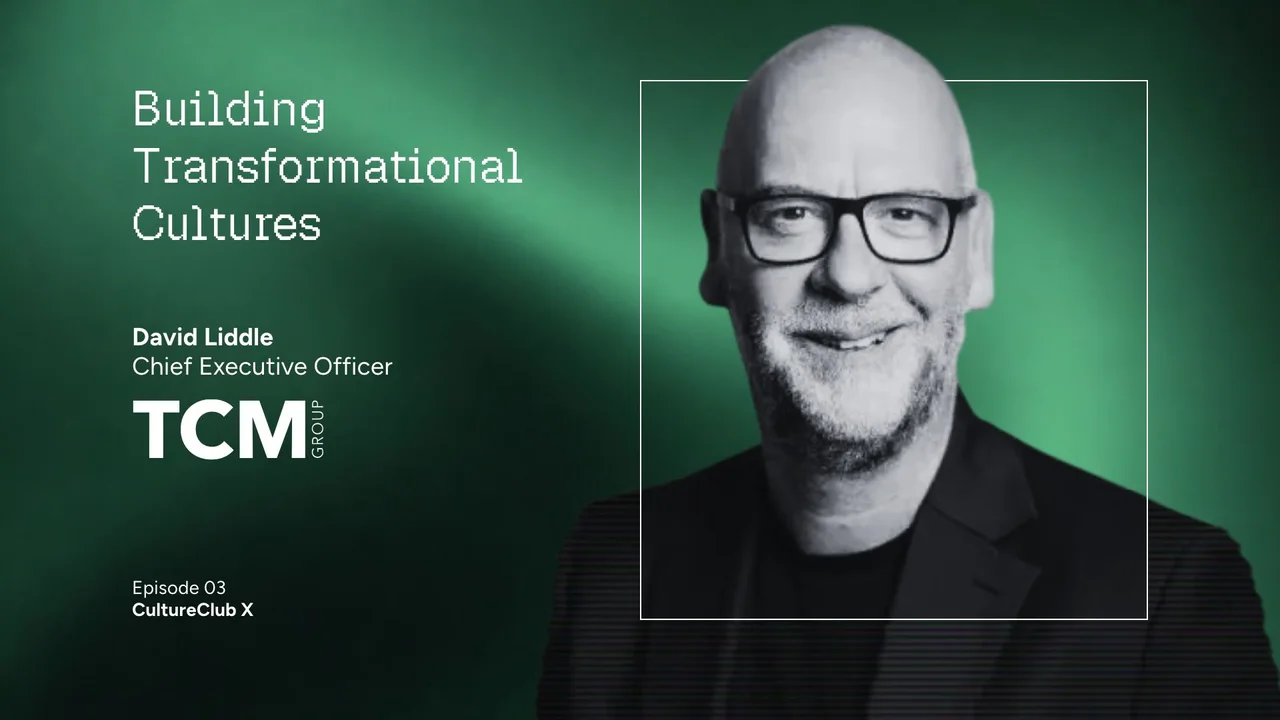
David Liddle is the CEO of The TCM Group, President of the People and Culture Institute and Editor-in-Chief of The People Leader magazine. He led a mediation and restorative practice charity before founding TCM in 2001, and he has written three books, most recently People and Culture: A Practical Guide. He was inducted into the HR Most Influential Hall of Fame in 2026.
This is the third episode of Culture Litmus, the Season 07 series on the gap between what organizations claim about their people and what they can evidence. David's subject is the gap between the culture an organization describes and the one its own procedures create.
What is a transformational culture?
A transformational culture, as David Liddle defines it, puts people, purpose and values at the heart of the organization and manages the relationship between employer and employee through dialogue, facilitation, coaching and mediation rather than through rigid rules.
He arrives at it through a short history of how work has seen the employee: first as a utility, then as a resource, then as an asset to be depreciated and a risk to be managed, then as a consumer of services, and now as a citizen, an active participant in the world of work. The systems most organizations still run were built for the earlier versions. They centralize power, rely on command and control, and manage people through investigation and formal process. His verdict is blunt: they do not work, and they probably never really worked.
What is the most common cultural problem in high-performing organizations?
David Liddle's answer is the grievance procedure, and the disciplinary process beside it. Asked for the single most common cultural pattern inside high-performing organizations that still struggle with fairness, he does not name leadership capability or manager skill. He names a document. His reason is that it seeds relationships based on right, wrong, win, lose, attack, defend. In his words it is about blame, shame, punish and destroy, and those behaviors become culturally normal. They show up in how managers handle disagreement and in how someone is treated when they challenge, disrupt or make a mistake.
The organizations he sees making progress are rewiring that justice model. They have decided they can be compassionate and compliant, empathetic and still hold people to account, tough and tender, fair and firm. The problem with the old policy is that it is binary, and work is not. Some of them, he says, are ripping out grievance and disciplinary processes and replacing them with something more progressive.
Why does David Liddle compare legacy HR to a casino?
Because, in his account, employees are dealt a bad hand from the minute they walk into the organization, and the house will always win. The part of his own model he finds missing most often is a people-first approach. Organizations talk about customer first, engagement scores and employee experience, and then it does not materialize in recruitment, onboarding or the employee handbook. The handbook opens with a welcome from the CEO and then lists what happens when you make a mistake, when you are bullied, when you underperform. The message, he says, is that it is geared against you.
In his casino the house is the legacy HR department. An employee in that system is treated as a risk and a threat, and the processes of work are designed to manage them as one. That breaks the relationship between employer and employee, and it shows up as low trust, poor morale, low productivity, high attrition and low engagement.
When people ask whether putting people first creates an entitlement culture, his answer is that trusting people and listening to them is how you find out what they already know: the answers to today's problems and to tomorrow's.
What is the Resolution Framework, and why replace the grievance procedure?
The Resolution Framework is David Liddle's alternative to grievance and disciplinary procedures. It resolves workplace issues through dialogue and restorative practice instead of fault and blame.
His case for replacing the old process starts with a question. David asks listeners to think of a recent grievance or disciplinary process in their own organization and to ask who benefited from it, and how it benefited the organization. He has put that question to conferences, boardrooms and round tables for 25 years, and he says not once has anyone told him there was any benefit. What he hears about instead is harm, fear, stress and cost. He puts that cost at 28 billion pounds a year in the UK, about a thousand pounds per employee.
Instead of finding fault, the framework asks what each party needs, assesses the situation through what he calls a resolution index, and builds a resolution around it. It rests on restorative practice, which he describes in simple terms as dialogue, compassion and psychologically safe, trauma-informed process. He says more than 2,000 organizations have adopted it. To leaders who ask how they could survive without a discipline and grievance procedure, his reply is that it is the best thing they will ever do, because it gives managers the space to address issues at source.
What is the business case for fairness and justice at work?
The business case, as David Liddle makes it, is that people who feel seen, heard and valued give more discretionary effort, innovate more and are more willing to challenge. To make that case to a board, he starts with a question the people function rarely asks itself: what is the value we are here to create? He measures it four ways: shareholder value, social value, stakeholder value and strategic value, the last being the alignment between the chief people officer and the chief executive. Then he looks at how a people function measures its value today, and his observation is that many are drowning in data but starving for wisdom.
The qualitative evidence matters as much as the numbers. In focus groups he hears the same sentences: people do not go to HR because they do not trust it, they expect it to become formal, or they use it only as a last resort. The alternative he listens for from managers is a phrase: I see you, I hear you, I appreciate you, I understand you, I value you. That, he argues, is the business case for discretionary effort, innovation and the willingness to challenge. Imagine 10,000 employees each giving 5% more discretionary effort because they are happy at work, he says, and you have created a whole new department.
He is equally direct about the cost of the opposite. Nobody is innovative at home watching reruns of Frasier because their boss is bullying them or the system is breaking them, and the received wisdom that this is acceptable has to be challenged.
Why does culture change lose momentum within 18 months?
David Liddle gives two reasons: culture becomes an initiative, or it gets subcontracted to HR. Before answering, he corrects the introduction: the training numbers quoted belong to his team of more than a hundred associate consultants, not to him alone. The first reason is that culture becomes an initiative, often one born from a crisis, with no resilience built in, and it is overtaken by the next initiative. The second is that culture gets subcontracted to HR, which often sits in a silo and may not want to be its sole custodian.
The organizations getting it right treat culture as shared ownership and build what he calls culture hubs, where people answer together who owns the culture and what they want it to look and feel like. He borrows a line from a TomTom advert he remembers from London: you are not stuck in traffic, you are traffic. His version for the workplace is that culture is not being done to you. You are culture, in every word you speak and every email you send.
What should every people leader do in the next 90 days?
Listen. David Liddle's one non-negotiable action for every people leader is to go and hear what their people need. He tells leaders to use their ears: go and give your people a jolly good listening to. Come down from the executive floor, ask how work is at the moment, what people need and how you can support them, and then actively listen to the answers. After years as a mediator, coach and consultant, the single universal truth he reports is that what people really want is to feel heard and to feel valued. His worry is that dialogue is being designed out of organizations while formality and command and control gain ground.
How do employee listening platforms help detect cultural drift early?
By giving managers the data to spot problems early and act on them close to the source. On real-time employee listening platforms, David Liddle's point is about proactivity: using data to inform decisions, spotting problems early and resolving them as close to the source as possible. The pattern he sees too often is a culture that avoids issues and then pays for an expensive overreaction. What a listening platform gives managers, in his account, is the tools for action. It will not always be right, but people can see action, momentum and connection. Acting quickly also matters psychologically: it moves people out of a fight-or-flight response to bad news and toward the state in which they do their best work.

About the guest
David Liddle
Chief Executive Officer, The TCM Group
David Liddle is the Chief Executive Officer of The TCM Group, President of the People and Culture Institute and Editor-in-Chief of The People Leader magazine. He led one of the UK's restorative justice and mediation charities before completing an MBA with distinction and founding The TCM Group in 2001.
He is the creator of the Transformational Culture Model, the People and Culture Operating Model and the Resolution Framework, and the author of three books: Transformational Culture, Managing Conflict and People and Culture: A Practical Guide. He was inducted into the HR Most Influential Hall of Fame in 2026.
Full episode transcript
Season 07, Episode 03 · David Liddle with Darcy Mehta · 36 min
Hello, everyone, and welcome to season seven of CultureClub X, powered by CultureMonkey. I'm your host, Darcy Mehta. CultureMonkey is an AI-powered enterprise employee engagement platform that helps people leaders listen to their employees and build stronger workplace cultures. CultureClub X is our global thought leadership forum where CHROs, people leaders, and workplace experts share insights, discuss emerging trends, and exchange Practical strategies for building thriving, future-ready organizations.
And today we are delighted to welcome David Liddle, CEO of The TCM Group, President of the People and Culture Institute, and editor-in-chief of The People Leader magazine. David, welcome. It's so wonderful to have you with us.
Darcy, it's fantastic to be here. Thank you for having me.
Yes, absolutely. So David is one of the leading voices in organizational culture, leadership, and workplace transformation. Over the past 25 years, he has advised thousands of organizations across the public, private, and not-for-profit sectors, helping leaders create more inclusive, people-centered and high-performing workplaces. He is the creator of the Transformational Culture Model, People and Culture Operating Model, Integrative Leadership. Cultural Citizenship and Resolution Framework.
He is also the author of three best-selling books, including Transformational Culture, Managing Conflict and People and Culture, A Practical Guide. David was inducted into the HR most influential Hall of Fame in 2026, adding to his recognition for his contribution to leadership, organizational development, and workplace transformation. David, your work has consistently challenged traditional approaches to people management and encouraged organizations to rethink how culture, fairness, dialogue, and performance come together.
Your focus on creating workplaces where people can thrive while organizations perform makes you an ideal voice for today's conversation. And we're excited to have you to discuss our latest topic transformational culture, how the world's best organizations build fair, just and high performing workplaces that actually last. Before we dive into the questions, could you just share a little bit about your own leadership journey?
Wow, Darcy, firstly, thank you for that introduction. It makes me sound quite busy. I have three kids as well and yeah, life's busy. So leadership is something that's really been at the heart of my work and journey for a great many years. I set up and led a charity promoting mediation and restorative practices in neighbor disputes, community disputes and community engagement. In the 1990s, I studied an MBA and secured a distinction examining... the role of dialogue, fairness and restorative practice in organizations. That really helped me to understand what leadership meant and also what it didn't mean.
And I kind of developed my thinking around leadership of something that we share, something that we give to others, something we help others to become. So I started to develop my leadership journey from that perspective and I now lead a large organization, a consultancy. As you said, I lead a big institute and also the editor of a magazine. So very much. thinking about how do I develop leadership in others and see my leadership as a gift that I try and share with others. That's how I think about leadership rather than a trait or a set of capabilities that I
That's amazing. Well, you have been busy, of course, and like Thank you said, somehow managed to have three kids. but you know, it's so interesting always doing this podcast, meeting so many wonderful people, and you bring such a unique perspective with all of your experience. So if you're ready, let's just dive into our first question. Love it. So you've said today's prevailing HR operating models remain focused on risk mitigation, control, and retribution, and that this system is holding organizations back.
So what does a Transformational Culture Model look like as an alternative and why are leading organizations moving towards it?
So I a lot of the systems, the legacy systems of the past Darcy were very much centered around the concept of the employee as a utility. Then we start to think about the employee as a resource and the strange term human resources. I'm not quite sure what that actually means. Human resources, the employee as a resource. Then we start to think about the employee as an asset, an asset to be depreciated, a resource to be managed as a risk. Then we start to think about the employee as a consumer or a user of services.
And that was extended into this period of transformationism, this new era of work, we're starting to think about the employee as a citizen, as an active participant in the world of work. And the old systems of the past, the legacy systems of the past, very much were about controlling the employee, centralization of power, authority, command and control, risk mitigation, investigative processes, formality and formal processes. And they don't work. probably, Darcy, never really worked. They certainly don't work now and they won't work in the organizations of the future.
Disaggregated, flexible, hybrid, high challenge environments, complex, ambiguous, disruptive. All of those elements cannot be fitted into a policy, a process or a procedure. So transformational culture puts people, purpose and values at the heart of our organization and builds out focusing on dialogue, engagement, learning, understanding and insight.
And rather than managing the relationships in our organizations between the employee and the employer through policies and processes and rigid rules and autocratic command and control models of leadership, it's centered through dialogue, engagement, facilitation, coaching, mediation, the kind of processes that bring people together that connect us. And in so doing, we connect to each other as human beings, but connect to the purpose of the organization, contribute. to the organization's sense of direction, its vision, its strategic objectives.
And in so doing, creates an unstoppable force within our organizations, which brings our employees with us, rather than seeing the employee as a tool or a resource or an asset or a utility within the direction of travel that our firms are moving with.
Hmm, that's the key, right? Bringing the employees with you and it's a journey together. I mean, leadership correct. looks so different now than it did in ancient times and not so ancient times even, right?
Indeed, and I think our organizations haven't really adapted to those changes, Darcy. We can all see the change. But our organizations haven't been so quick to adapt. I think a transformational culture provides the blueprint and a framework that helps the organization adapt to the new reality of work.
Absolutely. You've spent more than two decades working with organizations across the public, private, and not-for-profit sectors, including FTSE 100 and Fortune 500 organizations. What is the single most common cultural pattern you
see inside high-performing organizations that still struggle with fairness
and justice? And why is it so difficult for them to recognize? Yeah, great question. There's a lot of different factors. When I was thinking about today's podcast,
I was reflecting on sort 10, 12 different factors. But to try and distill that into one, I'm gonna come up with one word or one phrase. It's the grievance procedure, Darcy.
The way that we handle complaints and employee concerns in our workplaces. Now, why have I focused on that? Why have I focused on this little document that sits within our organization?
Why have I not looked at the whole system and focused on...
leadership capabilities, managerial competences. The reason I've focused on the grievance procedure as a cultural norm within organizations and what that's really changing quickly is because
it seeds a relationship in our organizations based on right, wrong, win, lose, attack, defend. It's retributive and punitive in nature. It's about blame, shame, punish and destroy. And what that grievance procedure does, I guess, the disciplinary process similarly. is it seeds within the organization defensiveness, hostility, retribution and blame and they become culturally normalized.
They show up in the way that we behave, the way that we interact, the way that we act, the way that we respond to situations, the way that managers handle change and disagreement, the way that I'm responded to when I speak truth to your power or I challenge you or I disrupt or I make a mistake. And so the grievance and disciplinary procedures talk and there is signal, there is symptom of retribution and action within our organizations and the organizations that you've talked about that are the ones I work with across the globe are rewiring their justice model.
Shifting from blame, shame, punish, destroy, right, wrong, win, lose. They're starting to say, do you know we can be compassionate and compliant? We can be empathetic and hold people to account. We can be tough, but we can also be tender. We can be fair and firm and we can hold multiple truths. And that's the problem with the policy that I've described is it's very binary. It has to be this or it has to be that, it's oppositional. We know work doesn't exist in that way. We know it operates in the gray space.
So why do we structure a justice model or an approach which forces us to take sides and pushes us then into adversarial systems? So that's my one symptom, if you like, or signal that I'm really excited to see organizations addressing. And in some cases, Darcy, dare I say it, even ripping out those grievances and disciplinary processes and replacing them with something much, much more progressive.
Hmm, that's so fascinating and you know, so true that you're right. We know that it's not so black and white, that's a gray area. You there needs to be a balance, but you know, why is it not set up like that currently if we know that too, that it's not so just this or that? It's like, okay, we can, like you said, be tough, but also be compassionate. So no, that's that's that's fascinating. Very good answer. Our Well, thank you. your People and Culture Operating Model is built on five domains. People, culture, strategy, justice, and leadership.
Which of these five is most consistently absent in organizations that claim to have a strong culture? And what does its absence actually cost to them?
Yeah, this is again, it's a great question because I think organizations that are getting this right are focused on all five of those domains and really leaning into. But the one that I struggle with the most and see sometimes missing the most Darcy is a people first approach. We often heard organizations talk about customer first and customer experience. We hear about employee engagement and NPS scores, net promoter scores and employee experience. But actually when we start to look at the organization through a people first lens, I see that then.
It doesn't materialize in our recruitment processes, our onboarding processes, even in our employee handbooks, Darcy. Welcome to your new job, says the CEO with our little faded signature on the start of the employee handbook. And thereafter in the employee handbook, this is what we do when you make a mistake, when you're bullied, when you bully someone else, when you underperform. So the message is, it's very much, it's geared against you. And when I work with organizations and look at the legacy systems, I often think of it as a casino. We walk in. to the casino.
And we are dealt a bad hand from the minute that we walk into the organization. And the house will always win. And the house is represented by the legacy HR department. And the house will always win. So it's not people first. It's a risk. And I am treated as a risk. I'm treated as a threat. And the systems and processes of work are designed to manage me as a risk or as a threat. And that then breaks down that social contract or the relationship between the employer and the employee. It shows up as unhappiness, a lack of trust, poor morale, low productivity, high attrition, low engagement, low health and wellbeing.
And all of those issues in large organizations might be hidden, hidden away. We might have a fighting fund to address the litigation that comes from this. But the smart leaders, Darcy, and I know you've spoken to many of them through the podcast. The smart leaders, they're saying, hang on, whoa, that's not how I want to run this organization. I want to run this organization by putting people first. And if we build out from the needs of our people, what motivates them? How do they feel? How can I help them to thrive and grow and develop and learn?
How can I create relationships when we disagree, when we fall out, when we fight? How can I engender innovation and creativity? You know, at this time of digital disruption, we need to be better at being human. We need to unlock that innovation and creativity and insight. And the best leaders I speak to, the people professionals, the people leaders, the executive leaders, the business managers, are saying, let's remove the legacy systems from our workplace and allow people to thrive and do you know something? People often say to me, is that not creating an entitlement culture? Does that not?
perpetuate the risk of the bad employee, the bad actor. But the reality Is it? is by trusting people and listening to people and engaging with people, they know the answers to the problems from today. And also critically, they know the answers for the problems of tomorrow. And that innovation and creativity is what generates the competitive advantage. And that creates the organization of the future, the workforce of the future, the future of the people function more widely.
Hmm, absolutely. I mean, people first says it all. That phrase encapsulates it, right? And like you said, I mean I if you think about it as a relationship. It's a relationship is two sided. So trust has to go both ways, knowing that you're you're you're valued and you're heard. And you know, it's funny you talking about the handbook, you know, I haven't worked in a corporate job in a long time, but I remember getting the handbook and you're right, it is like a casino. It's like, okay, here's all of the things, you know, and this is what will happen if you mess up and everything, and that the house always wins.
And when you're starting something right up, you know, you're starting on the wrong foot right away like that. So, it's so fascinating. from day one, from day
one of your work, you're starting on the wrong foot. How can you be a truly productive, engaged employee within that environment? It becomes very, very hard to manage that. And then we see managers struggling and leaders struggling and HR professionals struggling. It's because it starts on the wrong foot from day one data.
Mm-hmm. Mm-hmm. When it's a them versus us mentality right away versus it should be all us because we're all working in this organization. And it seems so obvious, doesn't it? But it's it's not, obviously. So okay, so you've pioneered the Resolution Framework as an alternative to traditional grievance and disciplinary systems. How can replacing retributive HR processes with resolution based approaches improve engagement, trust and retention, and what prevents most organizations from making that shift?
It's a big question. I mean, I'd like to pose this question back to some of your listeners for the podcast. I'd like them think about a grievance process or a disciplinary process that happened recently in their own organization. It might be one that they managed, Darcy. It might be one that they were part of. It might be one that they had to deal with the investigation or the hearing. I'd like them to ask themselves a very deep question of who benefited from that process and how did that process benefit the organization? and do have a very kind of critical reflection.
And when I do this, I go out and talk at conferences, I talk in boardrooms, I talk in management suites, I talk in round tables. And I asked that question. And do know something, Darcy? I've been asking that question for 25 years and not once has anyone said to me there was any benefit from delivering that process. All they talk to me about is the harm, the trauma, the fear, the stress, the anxiety, the cost. Wow. 28 billion pounds a year in the UK, just in the UK, that's a thousand pounds per employee per year cost. No one benefits, they don't work.
So the Resolution Framework says, look, let's take a new approach. Let's develop a new system for resolving issues. Instead of trying to find fault and blame and retribution, let's think about how do we resolve this problem? How do we understand what the parties need? I introduced what I call a resolution index. Let's understand what it is that you're looking for. Let's assess the situation and tailor build a solution around each of the party's needs. It focuses primarily Darcy on restorative practice, which in simple terms means dialogue, compassion, healing, trauma-informed practices, psychologically safe.
Now that might sound, how does that fit within the tough world of HR? It fits within the tough world of HR because it's about putting people and human beings right at the center of the process. And in the organizations that I've worked with, over 2000 have adopted the Resolution Framework, indeed many more. Not one of those organizations I've worked with have experienced an adverse or negative effect in the courts or through litigation. Now bearing in mind, I've worked with big media companies, banks, financial institutions. If they were being sued, they would be telling me, David, this process doesn't work.
So not only does it help to address the issues at source, it de-risks. the organization's HR policies and processes. So people often say to me, gosh, David, how could we survive without a discipline and grievance procedure? And I say to them, it's the best thing you will ever do. Because what it's starting to do is give you the space, giving you the opportunity to be able to address issues at source, upskilling your managers and put resolution first, rather than grievance blame, sanctions, adversarial, exhausting. tiring, broken, dysfunctional, toxic relationships at the center of your organization.
It's liberating and it's incredibly, incredibly powerful.
Hmm, that's the key, just tur putting resolution first and everything stems from that. Indeed. so this is related. you've argued that psychological safety, dialogue, and justice are not soft concepts. They are structural foundations of high performance. So, how can HR leaders make the business case for fairness and justice to a board that primarily speaks the language of productivity, performance, and profit?
It's a really great question. I really love that. So thank you. I think it talks about what's the value of our organizations and what's the value of the people function. And I don't think we have that conversation enough Darcy and our organizations. Why are we actually here? What's the why? Now, when I explore value, I think about value and I see value measured in terms of profit. So shareholder value. I see value measured in terms of social value, the impact on the firm, on the planet and on the local community.
Stakeholder value, how do we measure our impact on all of the stakeholders that exist in our workplace? And strategic value, the relationship between the chief people officer and the chief executive officer to drive alignment between the people plan and the people strategy. So when we work with organizations, we start to deconstruct what does it actually, what's the why? What are you trying to achieve? What value are you trying to generate? And then we start to develop measures and tools to help the organization gather data about current value.
How do you currently measure your value as a people function, which is often, as I've seen in many people functions, that they're drowning in data, but starving for wisdom. And it's very much the case of what does the data currently tell you? What are the data telling you about where your current state is? And then really important, and this is the conversation I love having with leaders and people teams, what's your desired state? Where do you want to be in terms of how you demonstrate value? What does that future look like? And how can we start progressing towards that?
And what that business case development does, what that desired state, that dream state, that hard data, also the qualitative data, what the stories that people are telling about their experience. know, again, going back to HR, I run focus groups and people will say these kind of words to me. I don't go to HR because I don't trust them. Or if I go to HR, I know it will become formal. Or I only go to HR as a measure of last resort.
or I don't tell my manager because I don't think my manager knows how to deal with these issues, or my manager will respect, react quite aggressively to some of my concerns around my feelings. So the stories that we hear, the narrative that we hear within the organization is as a mistrust, a disconnect, the dissonance between the needs of the employee and the needs of the organization. So the business case is around what does value look like now? What are you trying to achieve? Where do you want to get to tomorrow, the next day, the day after that?
And how do we bring our people with us to build trust, to build connection, to build a sense of belonging so that we hear this, I love this phrase when I'm working with managers and I hear this a lot, not as much as I'd like, but I'm hearing it more. I see you, I hear you, I appreciate you, I understand you, I value you. And when we hear those statements being made by our leaders and managers, and that we're really listening to what people are saying.
That's the business case for high performance, for extraordinary discretionary effort, for innovation, for creativity, for risk taking, for daring to challenge, to listen, to engage. And that's the competitive advantage that our people first transformational culture can bring in our organizations. Imagine an organization of 10,000 employees. If everyone just felt a little bit more like putting 5% discretionary effort in because they feel happy in our workplace, aggregated that across 10,000 employees, you've suddenly created a whole new department in your.
Absolutely. I mean, innovation and creativity and change only comes about when you feel that there's a safe place to do that and you're in you know, there is a trust and that you are seen and heard and valued, like you said. And I like that phrase in the beginning of when you were answering you said a lot of organizations are drowning in data but lacking in wisdom. And I'm like, That's so true. So knowing the desire, the why, what do you want to achieve is so important.
And you can't be innovative watching reruns of Frasier at home because your boss is bullying you or the system is breaking you. So we have to really understand what is it that people want and what is it that people need and really challenge the received wisdom that is okay. It's not okay. That one relationship that's breaking down, that person who's off work for a week or two weeks or three months or six months or even longer, that is not okay. And we also have to ask ourselves in the development of a transformational culture, some pretty tough questions. What does good work look like?
What do we want it to feel like? And then we can start to build and shape the organization where people thrive, where our leaders will grow and the organization, Darcy, is going to excel.
So, David, you've trained more than 30,000 people and worked across sectors, ranging from government to global enterprises. So, what does sustainable culture change actually require that most organizations are unwilling to commit to? And why do so many culture transformation programs lose momentum within 18 months?
Yeah. So just to say as well, 30, I mean, I've got a huge global team. We work across the world delivering training programs, over a hundred associate consultant partners and a great team in our head office in London. So I just want to acknowledge their incredible work, Darcy, if only it was all me. But I just want Absolutely. to say that it wouldn't, wouldn't, it wouldn't happen as I'm sure you've heard this many, many times before. It wouldn't happen without the great, the great team behind me. Well, that's
the sign of a good leader to recognize your team, right? So
Yeah, I know. Thank you. Thank you to them and thank you for your recognition as well. I think there's a couple of things I think that can cause it to fall by the wayside. I think the first one is it becomes an initiative and sometimes it's an initiative drawn from crises. So there's a storm on social media or there's some sort of adverse litigation or some problem statement. And that problem statement means everyone hurriedly runs together and creates an initiative. But the initiative doesn't really have sustainability resilience built within it. And it addresses whatever the issue was.
But like many initiatives in our workplaces, it slowly falls by the wayside and gets overtaken by another initiative or what the next big project is from the board. I think that's the first one. I think the second challenge is we sometimes subcontract culture to HR or to no one but to HR. And I don't think HR necessarily want to be the custodians of that. And we know that HR often sit within a siloed environment. So it's not as collaborative as you and I might like it to be. So the organizations that really are getting culture right see culture as a shared ownership.
They build culture hubs, what I call a culture hub, bringing people together, answering the important questions of who owns the culture of this organization? What do we want the culture to look like? What do we the culture to feel like? How can we all work together? to move culture from an initiative or a subcontracted approach to something that we are all in. There's a lovely TomTom advert. You know, when I used to live in London, it was a TomTom advert. And it said, you are not stuck in traffic, you are traffic. It always stuck with me. And it speaks about culture.
Culture isn't being done to you, you are culture. every word you speak, every email that you send, every connection with your customer, every interaction with your colleague. And what I think is really critical is the people function, the old name HR, the new name, the people and culture function, that function brings people together and helps them to generate a culture that will help the organization to thrive. Wow, that's, think, when we start to see real progress being made.
That's a great advert. And that is very kind of like you know, mind-blowing because yes, everyone says, traffic, but you are traffic. You are the traffic. You are culture, you know. That's a that's a great way to apply that. So no, it makes perfect sense. So I love this next question because this kind of forces you to think of one thing. So, what is the one non-negotiable action every people leader should take in the next 90 days to start building a transformational culture? One that is fair, just, and genuinely. High performing rather than simply being described that way.
So the one thing I think, well, there's two things, but they're actually stuck here, so they're the same. They're called your ears. Go and give your people a jolly good listening to. Go and hear them. Go in and connect with them. Come down from the eighth floor executive suites and all of the other places where we hang out and go and find out what your people need. Ask them some questions. Be curious. How's work for you at the moment? What do you need? How are you feeling? What can I do to support you? How can we work together to address whatever those challenges are?
Ask questions, be curious, but more importantly, is actively listen to what your people are saying. And in all of my years as a mediator, as a coach, as a restorative practitioner, as a trainer, as a cultural change consultant, there's a single universal truth that exists within our organizations is all people really want to have is to feel heard, to feel heard, to feel valued. We want to earn money. Of course we want to earn money. We want to feel safe. We want to feel connected. But more than that, we want to feel heard. And you can address that by listening to people.
And I worry, Darcy, that dialogue is designed out of our organizations. Polarization and fear and uncertainty, formality, autocracy, command and control seems to be gaining traction. But I believe personally and professionally, and all of the evidence stacks up. that actually when we strip all of that back and really listen to what another human being says, we connect with them in the most profound, incredible way. And in that moment, that's the opportunity for us to find new meaning in our relationship and new opportunities to solve the problems in our organizations.
And surely, isn't that not the responsibility of leaders is to find the solutions to today's problems and to build a successful business for tomorrow. So that's my one piece of guidance, go and listen. hair.
That is that is perfect. We could leave it right there. I mean, that's so true in all relationships, personal and professional. That is what everyone wants. It's it's to feel heard. And that way, you know, even if that problem, you know, is even if it's not solved directly, it's just knowing that you're heard and understood. That's, you know, obviously the biggest thing. So and funny that you said that because my n last question is how can real-time employee listening platforms like CultureMonkey help?
Organizations detect early signs of cultural drift and give people leaders the data they need to course correct before fairness, trust, and performance begin to erode.
I love that. think it talks to me about proactivity. It talks to me about the ability to use data to inform decision making and then to act on that data to be able to spot problems early and resolve issues as close to source as possible. The problem I've sort of expressed through this podcast and I believe very strongly is we just think we just avoid dealing with issues. I see a cultures at work Darcy, which I describe very simply as extensive inaction. an expensive overreaction. And what your platform does, it gives us the tools for action. Now, it won't always be right.
You might make some mistakes, you might get it wrong, you might misinterpret it, but people can see action. People can see momentum, people can see connection, people can see listening and what your platform does and what that ability to be able to listen and hear in real time does is it gives us as managers and leaders the tools that we need. to have the conversations to address those issues at source or as close to source as possible. That means we can get on and do the hard work of running the organization.
And who knows, who knows, you may just unlock the solution to your next big customer challenge and skyrocket the business into hyper growth as a result. Wow, wouldn't that be great?
Mm-hmm. Yes, absolutely. I mean, just taking that action, like you said, is so important, taking that first step. And I know there's that famous the five second rule. And I've recently been trying to apply that in my old life. I heard about it recently and I haven't read the book, but you know, it's that five, four, three, two, one, go. And you just, without thinking, you just do it. So it kind of made me think of that when you were mentioning just, you know, taking action. That's that's so important. So
And avoid it. So I think what that does as well at five seconds is it just avoids, so the amygdala, part of our brain sees threats. So sometimes data and all the data and problems, they generate this sort of threat response, fight or flight response, cortisol, stress, all of the horrible stuff. What this does is it reduces the chances of that happening. You're acting quickly. You're moving from fight or flight into flow. So positive psychology, the work of Martin Seligman, Daniel Pink and others.
as identifying flow and what the data does, it moves us then towards a flow state of listening, connection and engagement. And that's when we do our best work. If we linger or avoid it or it becomes confrontational, it pushes us into fight or flight. And then it's very hard to move out of that. So I think you're describing that is the ability to move quickly into flow. And that's where I think we do our best work. It's not always easy, but that's where we do our best work. And that's where coaching can help, mediation can help, because it can help us move into the flow state.
Whereas actually stasis or confrontation or adversarial, that creates harm and trauma. yeah, I think that the data is fundamentally important to help us address that particular challenge.
So true about flow and everything. And well, I would love to keep chatting and I could I could dive into so much more with you, but I don't want to hold you too long. So, David, thank you so much. And today's conversation has highlighted an important distinction. A strong culture isn't created simply by defining values or launching culture initiatives. It is built through the systems, behaviors, conversations, and decisions that determine. Whether people experience fairness, trust, accountability, and high performance every day.
Your perspective also reinforces that fairness and justice aren't separate from business performance. They are part of the foundation that allows people and organizations to perform at their best over the long term. That's where continuous listening can play an important role. With pulse surveys and real-time employee feedback, platforms like CultureMonkey can help people leaders. Understand how employers are experiencing culture, identify emerging concerns around trust and fairness, and spot potential areas of cultural drift early enough to take meaningful action.
And before we end, David, how can our listeners connect with you to continue the conversation or learn more about your work?
Darcy, thank you very much. So I guess like many of us, we're on LinkedIn, so you can find me on LinkedIn. My main website is thetcmgroup.com, so www.thetcmgroup.com. And of course, if you put in my latest book, People and Culture by David Liddle into Google, it will bring you onto your Amazon site. And please do grab a And if I bump into you, I'll be very happy to sign it as we're going along. But those are just some of the ways you can track me down, Darcy. And of course, the other thing I would say as well is do subscribe to our magazine, The People Leader magazine. It's a fantastic publication.
We produce it every couple of months. It tells stories and case studies from chief people officers and CEOs. And it's really powerful and it's free to subscribe. So if anyone would like to, it's thepeopleleader.com, www.thepeopleleader.com and we'll get your copy into your inbox and I hope you enjoy it.
Perfect. Well, thank you so much, David. I'll definitely subscribe and connect with you on LinkedIn. And in the day and age of digital media, I'm so glad you've got physical copies too, because I still love my magazines as well. So and to all our listeners, thank you so much for being here. Don't forget to follow, share, and subscribe. And that's a wrap for this episode of CultureClub X, powered by CultureMonkey. Until next time, I'm Darcy signing off.
Frequently asked questions
Who is David Liddle?
David Liddle is the Chief Executive Officer of The TCM Group, President of the People and Culture Institute and Editor-in-Chief of The People Leader magazine. He led a mediation and restorative practice charity before founding The TCM Group in 2001. He created the Transformational Culture Model, the People and Culture Operating Model and the Resolution Framework, and has written three books, including People and Culture: A Practical Guide. He was inducted into the HR Most Influential Hall of Fame in 2026.
Why does David Liddle say the grievance procedure damages culture?
Because of what it teaches. In his account the grievance procedure, and the disciplinary process beside it, seed relationships based on right, wrong, win, lose, attack, defend. He describes them as retributive and punitive, about blame, shame, punish and destroy, and says that defensiveness and blame then become culturally normal. They show up in how managers handle disagreement and in how people are treated when they challenge something or make a mistake.
How much does workplace conflict cost, according to David Liddle?
On CultureClub X he puts the cost at 28 billion pounds a year in the UK, which he describes as about a thousand pounds per employee per year. He raises it alongside a question he has asked leaders for 25 years: who benefited from your last grievance or disciplinary process, and how did it benefit the organization? He says nobody has ever told him there was a benefit.
Does putting people first create an entitlement culture?
David Liddle says leaders often ask him this, and his answer is no. In his view, trusting people, listening to them and engaging with them is how an organization reaches what its people already know: the answers to today's problems and to tomorrow's. He argues that the innovation and creativity this releases is what generates competitive advantage.
What are the four kinds of value David Liddle says a people function creates?
Shareholder value, measured in profit. Social value, the impact on the firm, the planet and the local community. Stakeholder value, the impact on everyone with a stake in the workplace. And strategic value, the relationship between the chief people officer and the chief executive officer, which he says drives alignment on the people plan and strategy. He uses the four to help a people function work out what value it creates today and where it wants to get to.
What is a culture hub?
It is David Liddle's name for a forum that brings people together to own culture jointly, instead of leaving it to HR. A culture hub answers questions such as who owns the culture of the organization, what people want it to look like and feel like, and how everyone can work together on it. He offers it as the alternative to treating culture as an initiative or subcontracting it to one function.
Read the cross-episode roundups
More from CultureClub X
 S07 E02change leadershipHR as Chief Disruption Officer: Why Supporting the Business Is a Ceiling, with Jennifer McClure
 Jennifer McClure
 S07 E01employee engagementWhy is employee wellbeing spending not paying off? | Gethin Nadin, Benifex
 Gethin Nadin
 S06 E20change leadershipWhy does culture change stall? | Jamie Notter, culture scientist
 Jamie Notter
Never miss an episode
Every new episode, plus the takeaways that matter, posted on the CultureMonkey LinkedIn page as soon as they drop.
Free on LinkedIn. Unfollow anytime.